Efficient and equitable urban roadway management favors higher value trips and more space-efficient modes over lower-value trips and space-intensive modes. This can justify bus lane networks in most major cities.



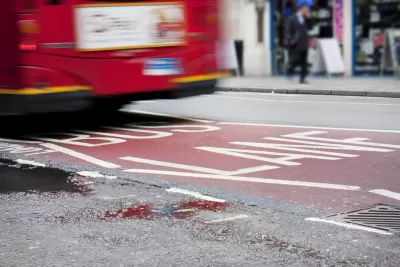
Next month I will present a paper at the Thredbo International Conference on Land Passenger Transportation titled, When is a Bus Lane Warranted? It examines where dedicated bus lanes are justified based on economic efficiency and social equity principles. This is an important and timely issue for cities around the world.
Cities are, by definition, places where many people and activities locate close together, so urban space is always scarce and valuable. As a result, efficient and equitable urban roadway management favors higher value trips and more space-efficient modes over lower-value trips and space-intensive modes.
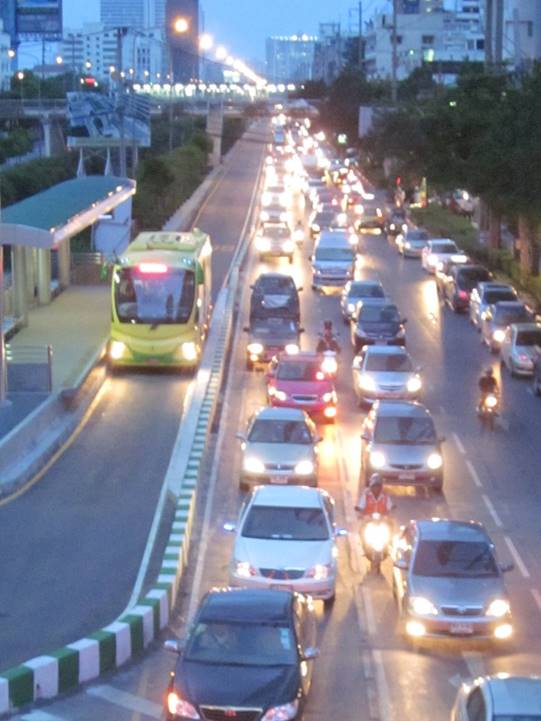
Bus lanes are a practical way to do this. They can carry an order of magnitude more people than a general traffic lane (see image below), and help achieve social equity objectives by ensuring that non-drivers are able to use a fair share of public road space, and helping physically, economically and socially disadvantaged people access economic opportunities. As Enrique Penalosa explains in this TED Talk, bus priority lanes, represent democracy in action by allocating public road space to poor as well as affluent residents.

Although a single bus lane may seem to provide only modest direct benefits, an integrated bus lane network implemented with other pro-transit policies can be the fastest and most cost-effective way of creating more multimodal cities where travellers choose the most efficient mode for each trip: walking and cycling for local errands, public transit when travelling on busy corridors, and driving only when it is most efficient overall, considering all impacts. Unfortunately, current transportation evaluation methods are unsuited to such analysis. Conventional traffic models tend to underestimate the impacts that high quality public transit and transit-oriented development have on automobile ownership and use, and conventional economic evaluation tends to overlook or undervalue many resulting benefits such as parking cost savings, increased traffic safety, and reduced chauffeuring burdens. We need better tools to help decision-makers decide when to implement bus lanes. The following table lists various types of benefits and costs that should be considered when evaluating public transit improvements, including dedicated bus lanes.
Public Transit Benefits and Costs
|
Category |
Improved Transit Service |
Increased Transit Travel |
Reduced Automobile Travel |
Transit-Oriented Development (TOD) |
|
Indicators |
Service Quality (speed, reliability, comfort, safety, etc.) |
Transit Ridership (passenger-miles or mode share) |
Automobile Travel Reductions |
Portion of Development With TOD Design Features |
|
Benefits |
Improved transit operating efficiency Improved bus passenger travel speed and reliability Option value (the value of having options that may sometime be useful) Equity benefits (since existing users tend to be disadvantaged) |
Direct benefits to new users Increased fare revenue Increased public fitness and health (by stimulating more walking or cycling trips) |
Reduced traffic and parking congestion, and resulting facility cost savings Consumer savings Reduced chauffeuring burdens Increased traffic safety Energy conservation Air and noise pollution reductions |
Additional vehicle travel reductions (“leverage effects”) Improved accessibility, particularly for non-drivers More efficient development (reduced infrastructure costs) Farmland and habitat preservation |
|
Costs |
Higher construction and enforcement costs Increased congestion in other lanes |
More crowded buses |
Reduced automobile business activity |
Various problems associated with denser development |
Bus lanes can have various benefits and costs that should be considered in evaluation. Some of these impacts are indirect and long-term, so their evaluation requires predictive modeling of travel and land development.
An ideal urban transit network provides high-quality service within a ten-minute walk of most homes, jobs and services, which requires a gird of grade-separated rail or bus lines spaced no more than a kilometer apart. Many cities are starting to implement bus lanes and other bus priority strategies. For example, although London is most famous for its subway system and congestion pricing, improving and expanding its bus lane network is a critical component of improving overall transit service quality and regional transport system efficiency. But there is far more potential.
In many situations, bus lane development will increase general traffic lane congestion in the short term, although this will decline over time as more travellers take advantage of the improved transit service, particularly if implemented with other transit-encouragement strategies. Comprehensive evaluation weighs this incremental motorist delay against transit travel time savings (including reduced bus operation and passenger travel time costs), reductions in automobile external costs including downstream traffic and parking congestion, accidents and pollution emissions, the social equity value of improving mobility for non-drivers, plus the strategic value of creating more multimodal transportation systems.

I found no simple warrants that define when bus lanes are justified. My analysis suggests that bus lanes are generally warranted where, after all economically justified pro-transit policies are implemented, they would attract more than 800 peak-hour passengers (about 20 buses) on surface streets or 1,800 peak-hour passengers (about 30 buses) on grade-separated highways, since those lanes carry more passengers than a general traffic lane, and so save total travel time, and by reducing urban-peak automobile travel, they provide additional indirect benefits, including reducing downstream congestion, providing road and parking facility cost savings, and by reducing traffic accidents and pollution emissions. As a result, more comprehensive evaluation can justify extensive bus lane networks in most cities, particularly rapidly-growing cities in developing countries.
What do you think? Are there other impacts and objectives to consider? Are there better ways to determine when bus lanes are justified? Are there better ways to communicate the value of high quality transit and pro-transit policies to decision-makers and the general public?

Philadelphia Bus Lane Enforcement Cameras Issued Over 112,000 Citations in First 7 Months
The bus-mounted cameras have helped increase bus speed by 3 to 6 percent.
Ann Arbor Opens First Bus-Only Lane
The new bus lane is part of a makeover of State Street that will make bus travel faster and more reliable.
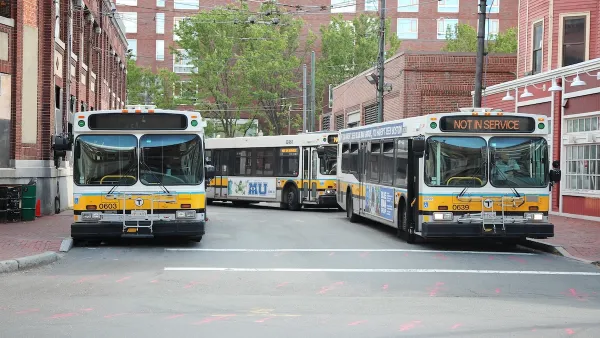
Boston Bus Signal Priority Project Yields Faster Travel Times
The city now plans to expand a year-long pilot project that reduced the time buses waited at traffic signals.

Amtrak, CN end decades-long dispute with eight-year agreement
The new operating agreement establishes an updated framework for the companies to work together, including processes to resolve disputes.

Northwest rail fans eager for Sept. 30 debut of Amtrak’s Airo fleet
Get ready for that new train smell and more seats. But they won’t go faster or run more frequently on the Cascades route in Washington and Oregon.

Judges permit Denver to divert 77,000 acre feet from the Colorado River for reservoir expansion
Overuse and climate change have caused the Colorado River’s water levels to plummet.

NYC to turn city-owned property into thousands of homes
The city has scheduled a public hearing regarding the development for October.

Buses travel at 5mph along this route in NYC. The Bronx's first-ever busway looks to change that
Prior to the busway, buses on the Bx36 route traveled as slowly as 5 miles per hour.

Pittsburg launches 'EZ permits,' aims for one-day turnaround for low-risk permits
The pilot ‘fast lane’ for permits is part of a bundle of modernization efforts for Pittsburg’s permitting process.

FREE Course: Walkable City 1: Why Walkability?
After describing his path towards focusing on walkability as the essence of good planning, Jeff Speck marches through his five principal reasons for making more walkable places.
Reinventing Malls: Planning Alchemy—Turning Gray Fields Into Gold
The course focuses on the opportunities and imperatives that shape reinvention of mall sites.

City of Thousand Oaks
City of Wisconsin Rapids
Harvard University Graduate School of Design
The Architects Foundation
University of Cincinnati Online
The Pocatello Development Authority
The Urban Renewal Agency of the City of Pocatello

