Does apartment-sharing reduce regional housing supply? Probably not very much.



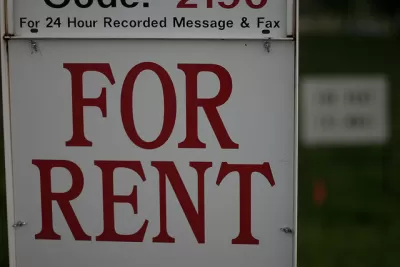
Over the past few years, the growth of Airbnb.com has made it much easier for people to rent out rooms in their houses and apartments. Before Airbnb, a traveler who wanted an alternative to hotels (which tend to be (a) quite expensive or (b) located in desolate-looking suburban arterials), would most easily be able to find a room through a temporary listing on Craigslist. However, these travelers had no way of knowing anything about their hosts, and would-be hosts had no way of knowing anything about their renters. By contrast, Airbnb, by providing a forum for hosts to review guests and vice versa, does allow some screening to take place.*
However, Airbnb has become politically controversial in high-priced, regulation-obsessed cities like Los Angeles and New York. Hotels and hotel unions quite understandably see Airbnb as competition in the short-term lodging industry, and wish to regulate it intensively (if not to destroy it). One common anti-Airbnb argument** is that Airbnb, by making short-term lodging more affordable, actually reduces the supply of traditional apartments—that is, apartments leased for a month or more at a time). The argument runs as follows: units that are on Airbnb for a few days at a time would, in the absence of Airbnb, be rented out as traditional apartments. Thus, Airbnb reduces the housing supply and raises rents.
This argument rests on an essentially unprovable claim: that Airbnb units would otherwise be rented out as traditional apartments. More importantly, the argument proves too much. If Airbnb hosts reduce the supply of apartments by not using their houses and spare rooms as traditional apartments, why isn't this equally true of hotels who are not using their rooms as apartments, or homeowners who are not renting out every spare room? And if homeowners and hotels are reducing the rental housing supply, why shoudn’t they be forced to rent out their units as traditional apartments?
Finally, the argument rests on the assumption that Airbnb includes a significant share of the rental housing market. For example, LAANE (a union-affiliated policy organization based in Los Angeles) recently issued a report claiming that Airbnb takes ,7316 units off the Los Angeles rental market, which “is equivalent to seven years of affordable housing construction inLos Angeles." But since Los Angeles produces very little "affordable housing" (whatever that term means) this statistic proves nothing.
A better way of understanding Airbnb’s impact, if any, on rents is to compare it to the total number of housing units in Los Angeles. There are just over 1.2 million housing units in the city of Los Angeles; thus, Airbnb units are roughly 0.6 percent of the housing market. There are about 700,000 rental units in Los Angeles—so even if every single Airbnb unit would otherwise be part of the rental market, Airbnb units would comprise only 1 percent of the rental market. (I very much doubt that this is the case, if only because since some Airbnb units are in privately owned homes and not every part-time Airbnb landlord wants a permanent roommate). Thus, it seems to me that even if every single Airbnb unit would be used as traditional apartments in the absence of Airbnb, its impact on regional housing markets would be small.
*Though perhaps not much: since the reviews are not anonymous, a host who reviews guests critically (or a guest who reviews hosts critically) may get negative reviews and less business in the future.
**This essay focuses on the relationship of Airbnb and affordable housing; however, I note that Airbnb does raise a variety of other legal and policy concerns unrelated to this little essay.

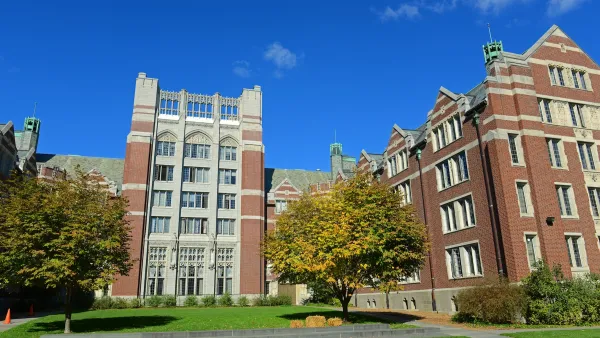
Wellesley sues state over proposed housing on state-owned parking lot
The college town opposes a 180-unit development that it says creates too much density for the area.

Louisville Launches ‘Anti-Displacement Tool’
After a years-long, tenant-led effort, Louisville will use a new tool to analyze whether a proposed housing development can meet a neighborhood’s housing needs and income levels. If it doesn’t, the city won’t subsidize it.
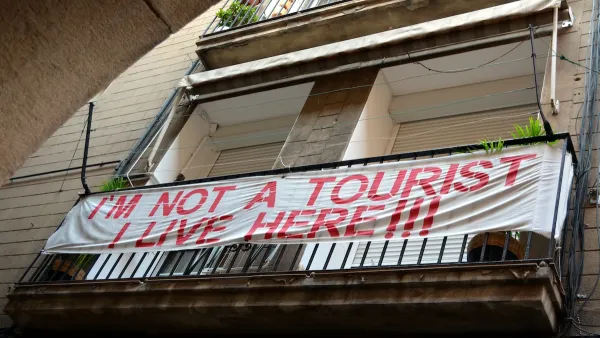
Barcelona Buys Building to Prevent Tenant Evictions
One apartment building — and its tenants who faced eviction — became a potent symbol of the city’s growing housing crisis.

Planetizen Federal Action Tracker
A weekly monitor of how Trump’s orders and actions are impacting planners and planning in America.

Northwest rail fans eager for Sept. 30 debut of Amtrak’s Airo fleet
Get ready for that new train smell and more seats. But they won’t go faster or run more frequently on the Cascades route in Washington and Oregon.

Record-breaking wildlife overpass in Colorado brings 91% reduction in animal collisions
Prior to the overpass, vehicles were hitting one deer per day on Colorado’s Interstate 25.

Detroit to transform waterfront with $2.2 billion investment
Developers will convert about 18 acres of unused parking lot space into civic spaces.

‘Going backwards:’ Baltimore mayor, students rally against state's transit funding plan
Maryland's proposed six-year plan provides no funding for Baltimore’s BMORE bus program and reduces its road maintenance funding.

Trump wants to cancel nearly 98% of funding for HUD housing support program
Multiple housing groups are suing the administration in an effort to preserve the funding.

FREE Course: Walkable City 1: Why Walkability?
After describing his path towards focusing on walkability as the essence of good planning, Jeff Speck marches through his five principal reasons for making more walkable places.
Reinventing Malls: Planning Alchemy—Turning Gray Fields Into Gold
The course focuses on the opportunities and imperatives that shape reinvention of mall sites.

City of Thousand Oaks
City of Wisconsin Rapids
Harvard University Graduate School of Design
The Architects Foundation
University of Cincinnati Online
Northern Illinois Transit Authority (NITA)
The Pocatello Development Authority
The Urban Renewal Agency of the City of Pocatello

