The Salt Lake Tribune looked at the development plans made possible by the West Side Master Plan for Salt Lake City.


Tony Semerad reports on the impending development of the western portion of Salt Lake City's downtown, an "often overlooked" neighborhood populated mostly by Latinos that continues to struggle with chronic homelessness.
Christopher Smart covered the adoption of the West Side Master Plan in September 2014, describing some of the planning mechanisms meant to drive the neighborhood's revitalization as well as the larger vision of the plan.
Semerad, however, delves into the development potential found in the neighborhood: Private developers, governments, arts and civic groups and a host of other powerful interests have multiple projects in the works around Rio Grande Depot, pushing downtown decidedly westward with millions of dollars in public and private investment. Some development deals have been a decade or more in the making; more are expected to follow."
In fact, writes Semerad, "[the] pending building boom has given a variety of key players — from some of Utah’s biggest developers to City Hall and the Utah Transit Authority — major financial interests in the area’s success."
Read the full story: Go west — new cry for Salt Lake City’s downtown development

Master Plan to Revitalize Salt Lake City's Struggling West Side
The Poplar Grove and Glendale neighborhoods in Salt Lake City perform poorly on the federal government's "opportunity index." A new master plan, however, would focus on transportation and nodes of activity to revitalize the area.
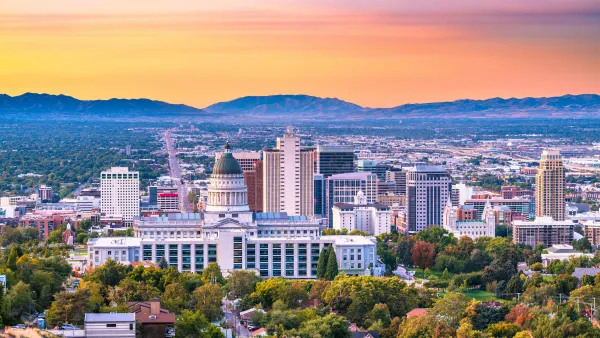
Salt Lake City Bucks Downtown Decline Trend
The city’s central business district is bustling with more activity than before the pandemic.
Critic's Review: Los Angeles Union Station Master Plan
Christopher Hawthorne details the finalized master plan for Los Angeles' remodel of its historic Union Station, saying the master plan positions the station to be a hub of activity in a remade city.

Planetizen Federal Action Tracker
A weekly monitor of how Trump’s orders and actions are impacting planners and planning in America.

Amtrak, CN end decades-long dispute with eight-year agreement
The new operating agreement establishes an updated framework for the companies to work together, including processes to resolve disputes.

Judges permit Denver to divert 77,000 acre feet from the Colorado River for reservoir expansion
Overuse and climate change have caused the Colorado River’s water levels to plummet.

Boston has spent millions making the Green Line more accessible — and there’s no end in sight
While the city has invested millions into expanding and adding platforms to the Green Line to make it more accessible, new train cars set to arrive next year will be too tall for disabled passengers to board without raising the current platforms.

Idaho may see an 18% drop in federal surface transit funding — the largest estimated cut in the US
Transit systems in rural communities are much more reliant on federal funding to provide their services.

How ‘post-disaster gentrification’ alters neighborhoods after natural calamities
After hurricanes, fires or other calamities, the original residents of a community are often replaced by younger, wealthier residents.

FREE Course: Walkable City 1: Why Walkability?
After describing his path towards focusing on walkability as the essence of good planning, Jeff Speck marches through his five principal reasons for making more walkable places.
Reinventing Malls: Planning Alchemy—Turning Gray Fields Into Gold
The course focuses on the opportunities and imperatives that shape reinvention of mall sites.

Harvard University Graduate School of Design
KFH Group Inc.
Greater Baltimore Committee
The Architects Foundation
University of Cincinnati Online
The Pocatello Development Authority
The Urban Renewal Agency of the City of Pocatello