For the last several decades, North American cities have used growth as a primary economic engine. Increasingly less dense new growth is subsidized by the more dense core, but requires a growth rate that is not supportable in the long term.


"Particularly in Sunburnt Cities and Rust Belt Cities, Smart Decline is replacing Smart Growth. Cities face a new imperative of behaving more like businesses, and less like ponzi schemes."
"We’ve been talking about this for awhile in the Why Placemaking Matters series. Taking it to the next step of detail, a City Valuation Study can mimic a mergers and acquisition team to mark to market two cities — one compact, and the other sprawling — to determine several economic, environmental and social measures."
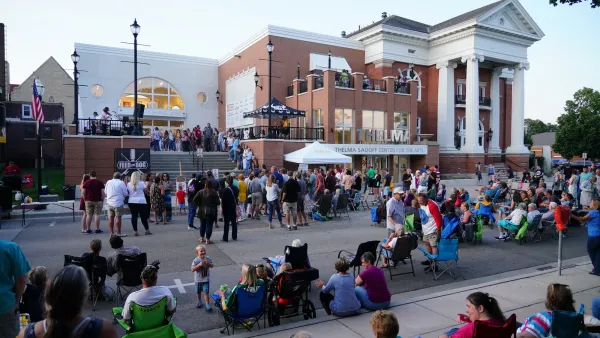
Hazel Borys goes on to detail how that city valuation study might work, and asks for a group-source on who might want to work on making it happen. A photo essay of Mesilla, New Mexico, shows how a modest uptick in urban density can create a notable boost in ROI.
Read the full story: A Comprehensive Accounting of Economic and Environmental Performance: Who’s in?


Green Cities: Breathe Deeply and Walk Freely
Greening the city extends our life and increases our quality of life.
How Does Placemaking Pay?
Hazel Borys compiles an extraordinary list of studies quantifying the role of livable, walkable places in building equity, city coffers, health, and social capital.
How Placemaking Lost its Way — And How it Can Get Back on Track
The term has often become diluted, getting attached to projects that don’t live up to its lofty aspirations.

Planetizen Federal Action Tracker
A weekly monitor of how Trump’s orders and actions are impacting planners and planning in America.

California plans to bury El Niño’s downpour
If the state plays its cards right, it may be able to store a billion acre-feet of El Niño’s water in aquifers.

Chicago breaks ground on $3 billion megadevelopment
The new neighborhood, titled Foundry Park, will one day host 3,700 residences.

California High-Speed Rail Authority CEO resigns after $600,000 scandal
Under Ian Choudri, the authority used taxpayer dollars to fund first class flights and trips to nightclubs.

Want to study the Missouri River? Soon, you may need unanimous approval from 10 states
Legislation would require 10 governors’ permission to study or build projects moving water outside the basin.

Desperate measures: Advocates weigh draining Lake Powell to fill Colorado River
Draining the reservoir could reduce evaporation losses by a couple hundred thousand acre-feet.

FREE Course: Walkable City 1: Why Walkability?
After describing his path towards focusing on walkability as the essence of good planning, Jeff Speck marches through his five principal reasons for making more walkable places.
Reinventing Malls: Planning Alchemy—Turning Gray Fields Into Gold
The course focuses on the opportunities and imperatives that shape reinvention of mall sites.

City of Rosemead
Rutgers University, Edward J. Bloustein School of Planning and Public Policy
One Hundred Miles
Hunter College, City University of New York (CUNY)
The Architects Foundation
University of Cincinnati Online
City of Cambridge
Montrose County
The Pocatello Development Authority