More cities—many of them "revitalizing" their urban cores at the same time as a national recession and a real estate market beset by diminishing supplies of low-income housing—are criminalizing homelessness.


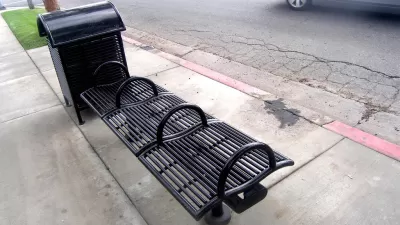
A report by the National Law Center on Homelessness and Poverty (NLCHP) "found that laws placing restrictions on loitering, begging, sitting and lying down in public have increased nationwide since 2009. Eighteen percent of cities now ban sleeping in public and 42 percent of cities ban sleeping in vehicles," according to an article by Xander Landen.
The cause of the ebbing of humanitarianism has everything to do with recent trends in urbanism, according to the NLCHP: "an overwhelming increase in urban homelessness after the recession and a widespread initiative to revitalize cities’ downtown areas incited the crackdown on the homeless."
Read the full story: More cities across the U.S. consider homelessness a crime

Utah to Build New, 1,200-Bed Shelter Campus
The state’s attempt to decentralize emergency homeless shelters yielded poor results, leading to a decision to develop a “transformative” intake campus with wraparound services.
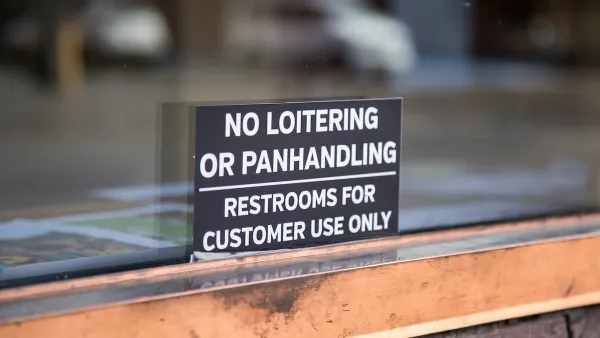
Opinion: Criminalizing Homelessness Is ‘Expensive and Shortsighted’
Policies that punish and fine unhoused people for sheltering outdoors, even when other shelter is not available, are the most visible but least efficient ways to reduce homelessness.

Planetizen Federal Action Tracker
A weekly monitor of how Trump’s orders and actions are impacting planners and planning in America.

California plans to bury El Niño’s downpour
If the state plays its cards right, it may be able to store a billion acre-feet of El Niño’s water in aquifers.

Chicago breaks ground on $3 billion megadevelopment
The new neighborhood, titled Foundry Park, will one day host 3,700 residences.

Want to study the Missouri River? Soon, you may need unanimous approval from 10 states
Legislation would require 10 governors’ permission to study or build projects moving water outside the basin.

Desperate measures: Advocates weigh draining Lake Powell to fill Colorado River
Draining the reservoir could reduce evaporation losses by a couple hundred thousand acre-feet.

This road in NYC is infamously dangerous — and Mamdani can't fix it
New York City's Ocean Parkway is known for reckless driving, but the power to implement safety measures lies with the state rather than the city.

FREE Course: Walkable City 1: Why Walkability?
After describing his path towards focusing on walkability as the essence of good planning, Jeff Speck marches through his five principal reasons for making more walkable places.
Reinventing Malls: Planning Alchemy—Turning Gray Fields Into Gold
The course focuses on the opportunities and imperatives that shape reinvention of mall sites.

City of Rosemead
Rutgers University, Edward J. Bloustein School of Planning and Public Policy
One Hundred Miles
Hunter College, City University of New York (CUNY)
The Architects Foundation
University of Cincinnati Online
City of Cambridge
Montrose County
The Pocatello Development Authority