Can a Parking Garage Village be Livable?

Students in Atlanta have designed a tiny house village inside a parking garage to help better understand how livable micro-housing projects can be.

3 minute read

July 16, 2014, 1:00 PM PDT

By jkress39


Empty Parking Garage

Comrade Foot / flickr

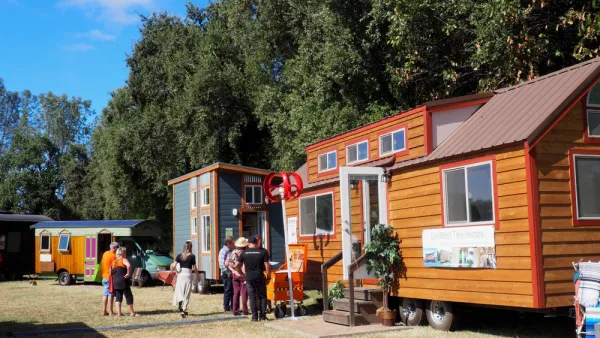
Savannah College of Art & Design’s students have designed and built three 135-square-foot SCADpads within their campus's parking garage. The SCADpads are fully equipped micro-dwellings within a village containing communal areas such as a community garden, living room, and work spaces.
"Exploring ways to develop flexible and low-cost housing in underused parking decks in high-density urban areas, the SCADpad project aims to push the boundaries of urban living" reports Jeroen Beekmans. "The designers have calculated that SCAD’s parking garage in Atlanta could accommodate up to 400 micro-homes."
Three of the student designers had lived within the village for one week to better understand how realistic micro-living within a parking can be. From the blog that the students kept during this trial period:  
"What takes the SCADpads from micro-housing to micro-living is all of the outdoor space. The pads are small, but they become so much larger when you factor in the outside areas. Living does not feel cramped because your daily rhythms incorporate a constant inside/outside movement that you don’t really even notice. You make breakfast inside, but step just behind you to eat on the porch next to the marigolds while checking email. Each pad has one of these porches: decks surrounded by potted plants and trees. These inviting little urban gardens are impossible to ignore and become integral to life in a micro-unit. “Life in a micro-unit” is not even an appropriate way to describe it. You’re not really living “inside” the micro-unit because living is a constant flow between the outdoors and the indoors."
Not everyone agrees that micro-housing comes without negatives. "Seattle's tiniest apartments are creating some of the city's biggest housing problems," writes Zak Burns. Communities have been fighting back against the recent wave of micro-housing and seek to have more restrictions placed on micro-housing developers. Opposing parties are convinced that micro-housing destroys the property values of the more traditional units surrounding the developments and creates additional burden for the neighborhood. Parking is already a major issue in the Eastlake neighborhood of Seattle and micro-housing "will only make it worse."
"The builder does not have to accommodate cars. Now prior to this kind of building you know any house that was built, any apartment that was built, any condo that was built had to provide at least one-car parking garage, a subterranean garage if it was a condo - per unit," said Eastlake Real Estate Agent Rick Miner. "Now they're talking 39 people and they haven't done, as far as we know, shown us any proof of who has cars and who doesn't have cars and [...] this is the United States. People own cars."
Micro-housing projects have appeared in cities such as New York, Boston, San Francisco, and Sao Paolo, Brazil.

Wednesday, July 16, 2014 in Pop-Up City

Young Professional

I love the variety of courses, many practical, and all richly illustrated. They have inspired many ideas that I've applied in practice, and in my own teaching. Mary G., Urban and Environmental Planner

I love the variety of courses, many practical, and all richly illustrated. They have inspired many ideas that I've applied in practice, and in my own teaching.

Mary G., Urban and Environmental Planner

Get top-rated, practical training for planners

"Planetizen federal action tracker" logo superimposed over black and white image of US Capitol dome.

Planetizen Federal Action Tracker

A weekly monitor of how Trump’s orders and actions are impacting planners and planning in America.

September 16, 2026 - Zachary Whalen

Passengers board an Amtrak train under a cloudy sky.

Amtrak, CN end decades-long dispute with eight-year agreement

The new operating agreement establishes an updated framework for the companies to work together, including processes to resolve disputes.

September 18, 2026 - Mass Transit

The Gross Reservoir, a large body of water surrounded by trees and mountains.

Judges permit Denver to divert 77,000 acre feet from the Colorado River for reservoir expansion

Overuse and climate change have caused the Colorado River’s water levels to plummet.

September 18, 2026 - Inside Climate News

A painted bus lane in NYC.

NYC DOT wants faster, more permanent street upgrades

The city is examining ways to build more concrete infrastructure without getting entangled in 'decades-long' projects.

September 21 - NYC Streetsblog

A woman looks at a utility bill.

'Something we’ve never seen before:' rising utility rates could strain city finances nationwide

Data centers, climate change and other factors have caused utility rates in the United States to increase by 38% since 2020.

September 21 - Smart Cities Dive

A person scuba diving in a coral reef off Guam.

Trump to overrule local leaders, lease millions of acres of America’s Pacific Island territories’ seafloors to mining companies

International law says that the Indigenous people of America’s territories have a right to prior and informed consent regarding projects that impact their countries.

September 21 - Grist