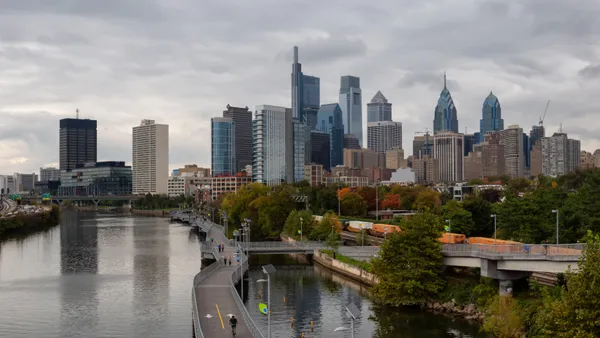
In November, Pennsylvania approved the state's comprehensive transportation funding plan, also known as Act 89. The plan will spend $2.3 billion over five years, and has provided a productive signal to regional and local transportation planning.


"For the first time in at least six years, the Pennsylvania Transportation Improvement Program (TIP) does not have an 'illustrative unfunded list.' Instead, thanks to the passage of Act 89, the recent state transportation funding legislation, the region will see an additional $1.2 billion for transportation improvements over the next four years," reports Christine Fisher.
The TIP "lists all transportation projects in DVRPC’s five-county Pennsylvania region that will receive federal funding over the next four years and all state capital improvement projects. For projects to advance, they must be included in the TIP."
In effect, the funding made available by Act 89 clears the way for the state to begin to clear the backlog. "This means long awaited projects like SEPTA’s City Hall/15th Street Station improvement will be able to move forward."
The new funding scenario has also compelled the Delaware Valley Regional Planning Commission to complete an amendment updated of its long-range plan, completed last year.
Read the full story: Act 89 improves fate of transit projects banished to the "unfunded list"
Opinion: Philly's Regional Transit Needs More Funding
The region's planning commission is pouring billions into highway widening projects while neglecting its public transit needs.

Arguing for Philly's Viaduct Rail Park Provide as a Mobility Solution
The High Line is a famous example of urban revitalization, but a useful commuter path it is not. Can a similar proposal in Philadelphia offer the benefits of beautification and mobility?
750-Mile Trail Network Near Philadelphia Receives $8.6 Million Gift
The William Penn Foundation has awarded $8.6 million in support for The Circuit—a planned regional network of bicycle and pedestrian trails for greater Philadelphia.

Desperate measures: Advocates weigh draining Lake Powell to fill Colorado River
Draining the reservoir could reduce evaporation losses by a couple hundred thousand acre-feet.

Eastern Nebraska is running out of electricity
Data centers and electrification are straining eastern Nebraska’s grid, throttling economic development.

Malls are becoming the midtowns of the future
Mall and office park redevelopments are a generational opportunity to create new nodes of urbanity.

NYC breaks ground on anti-flooding infrastructure project
New York City's new system will reduce stormwater flows to local sewers by 90%.

One Kentucky town’s secret to affordable housing
The Smoketown Community Land Trust has already built seven affordable homes for community members.

Houston gains petal-shaped cooling infrastructure to make streets more ‘delightful’
The city has installed the pavilions along 15 blocks in Houston.

FREE Course: Walkable City 1: Why Walkability?
After describing his path towards focusing on walkability as the essence of good planning, Jeff Speck marches through his five principal reasons for making more walkable places.
Reinventing Malls: Planning Alchemy—Turning Gray Fields Into Gold
The course focuses on the opportunities and imperatives that shape reinvention of mall sites.

City of Rosemead
Rutgers University, Edward J. Bloustein School of Planning and Public Policy
One Hundred Miles
University of Michigan School for Environment and Sustainability (SEAS)
Hunter College, City University of New York (CUNY)
The Architects Foundation
City of Cambridge
Montrose County
The Pocatello Development Authority