A new benchmarking report on biking and walking reveals a big hole in this growing movement — many ped-bike advocates rarely talk to urbanists, and vice-versa.


Bicycle and pedestrian advocacy has become a huge movement, with more than 220 state, provincial, and local advocacy organizations that are members of the Alliance for Biking & Walking. The alliance recently published out its annual Bicycling and Walking in the United States, 2014 Benchmarking Report.
The 260-page book, which can be downloaded online or purchased in print, is a tremendous research effort — despite the criticisms I am about to deliver. I would recommend it to anyone interested in this subject.
Among the good news: Walking and bicycling are on the rise, gradually, and becoming safer. Bike share programs are surging.
Yet this report also reveals a big hole in this movement — many ped-bike advocates rarely talk to urbanists and vice-versa. The report has about 40 authors and reviewers – representing major nonprofit, academic, and government institutions. They appear to be only vaguely aware of a key factor in the success of nonautomotive transportation: Place-based planning and development.
Read the full story: Ped-bike advocates and urbanists: Get together
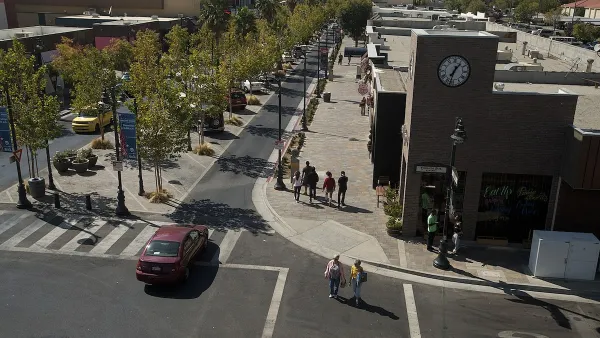
The Vast Potential of the Right-of-Way
One writer argues that the space between two building faces is the most important element of the built environment.
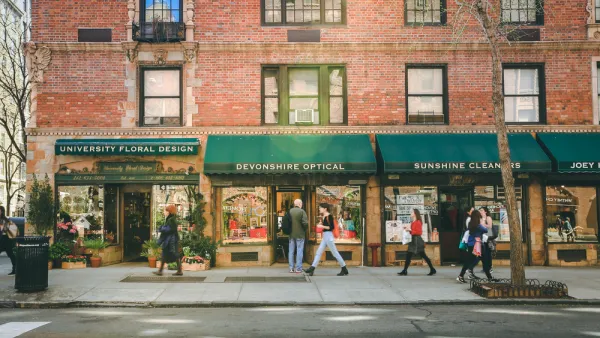
Livable Streets, Revisited
The updated version of Donald Appleyard’s 1982 book Livable Streets, written by Appleyard's son, dives even deeper into the ‘ecology of the street,’ proposing actionable solutions for the conflicts and problems facing urban environments today.
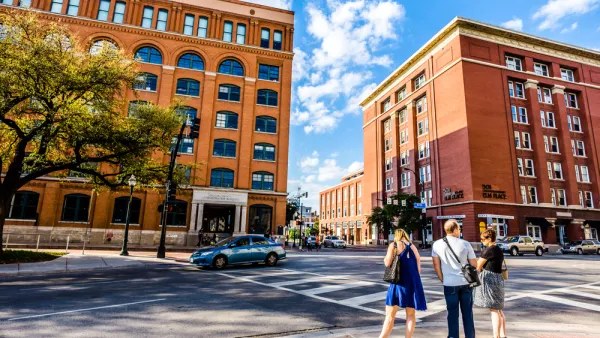
A New Vision for Dallas’ Dealey Plaza
After decades of neglect, a team of designers reimagines the infamous plaza as a safe, vibrant, multimodal public space.

Planetizen Federal Action Tracker
A weekly monitor of how Trump’s orders and actions are impacting planners and planning in America.

California plans to bury El Niño’s downpour
If the state plays its cards right, it may be able to store a billion acre-feet of El Niño’s water in aquifers.

Desperate measures: Advocates weigh draining Lake Powell to fill Colorado River
Draining the reservoir could reduce evaporation losses by a couple hundred thousand acre-feet.

In Texas, data centers are swallowing promised parkland
Residents who moved to Taylor, Texas for a rural community now have to contend with three data centers in their backyard.

How a Chicago-sized wind farm beat the odds and powered on
The project spanned five presidential administrations and a standoff with a U.S. military base.

MTA gives itself 30 days to transform pit into basketball court
The site has been under construction since 2022; the city originally estimated it would finish the court in 2024.

FREE Course: Walkable City 1: Why Walkability?
After describing his path towards focusing on walkability as the essence of good planning, Jeff Speck marches through his five principal reasons for making more walkable places.
Reinventing Malls: Planning Alchemy—Turning Gray Fields Into Gold
The course focuses on the opportunities and imperatives that shape reinvention of mall sites.

City of Rosemead
Rutgers University, Edward J. Bloustein School of Planning and Public Policy
One Hundred Miles
Hunter College, City University of New York (CUNY)
The Architects Foundation
University of Cincinnati Online
City of Cambridge
Montrose County
The Pocatello Development Authority