A post on the iStrategyLabs website describes some of the software and hardware requirements for building signs that display the arrival and departure of transit in your area.


The blog post describes the relatively simple system requirements for a real-time transit display in the office of iStrategyLabs in Washington D.C.: "The first step in building Transit [the display] was choosing the hardware. I decided to go with six LED matrices that provided a similar aesthetic to the real metro signs, one Arduino Mega to power the LEDs, and an Electric Imp to collect the desired data."
After selecting the hardware, all that was left was to decide how much information to display, in this case: "the next four trains arriving at the Dupont Circle metro, how many Capital Bikeshare bikes were available at the Dupont station, and the current temperature for Washington, DC."
Who else wants one?
Read the full story: Meet Transit, The Latest In Commuter Technology


Tips for Transit in the Age of Uber
Hate it or love it, Uber has changed the transportation game across this country. To boost ridership and change its public image, transit should consider taking some cues from the rideshare giant.
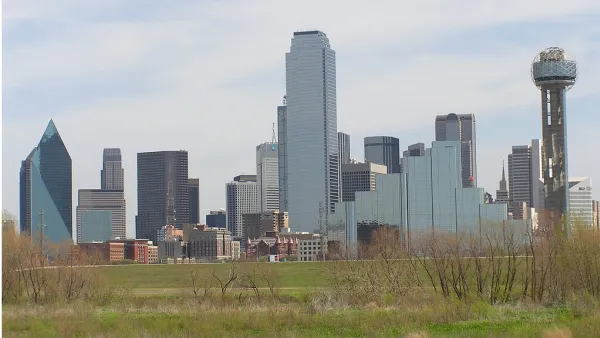
Dallas Addresses Transit-Dependent Poverty
In Dallas poorer people often rely on transit, a familiar pattern throughout the United States. But when car ownership grants access to opportunity, this can be a problem.
Post-Car? Helsinki's Plans for a Tech-Enabled Mobility Network
Helsinki, capital of Finland's, is working to create a "mobility on demand" system that integrates shared and public transit in a single payment network. The idea is that with such a system in place, residents would no longer need cars.

Planetizen Federal Action Tracker
A weekly monitor of how Trump’s orders and actions are impacting planners and planning in America.

Amtrak, CN end decades-long dispute with eight-year agreement
The new operating agreement establishes an updated framework for the companies to work together, including processes to resolve disputes.

Judges permit Denver to divert 77,000 acre feet from the Colorado River for reservoir expansion
Overuse and climate change have caused the Colorado River’s water levels to plummet.

NYC DOT wants faster, more permanent street upgrades
The city is examining ways to build more concrete infrastructure without getting entangled in 'decades-long' projects.

'Something we’ve never seen before:' rising utility rates could strain city finances nationwide
Data centers, climate change and other factors have caused utility rates in the United States to increase by 38% since 2020.

Trump to overrule local leaders, lease millions of acres of America’s Pacific Island territories’ seafloors to mining companies
International law says that the Indigenous people of America’s territories have a right to prior and informed consent regarding projects that impact their countries.

FREE Course: Walkable City 1: Why Walkability?
After describing his path towards focusing on walkability as the essence of good planning, Jeff Speck marches through his five principal reasons for making more walkable places.
Reinventing Malls: Planning Alchemy—Turning Gray Fields Into Gold
The course focuses on the opportunities and imperatives that shape reinvention of mall sites.

Harvard University Graduate School of Design
KFH Group Inc.
Greater Baltimore Committee
The Architects Foundation
University of Cincinnati Online
The Pocatello Development Authority
The Urban Renewal Agency of the City of Pocatello