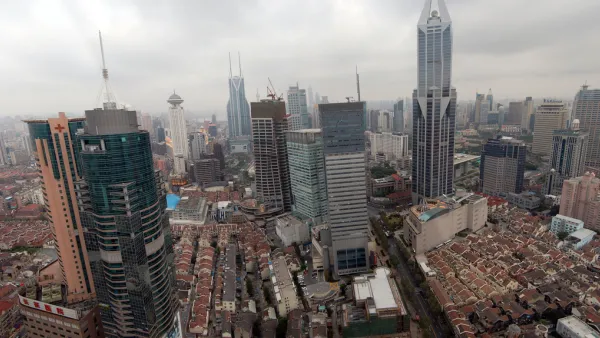
China's rapid urbanization has been built by a class of citizens called "nongmin," or peasants, many of which have migrated to urban areas for work but retain their legal status as residents of the countryside.


A recent article by David M. Barreda describes the plight of rural migrant workers in China—a "uniquely Chinese social identity" of citizens no longer working in agriculture but who retain legal status as nongmin ("peasants"). In fact, "[of] China’s 263 million 'peasant laborers' more than 60% are migrant workers, living in cities but legal residents of the countryside."
Migrant workers are an essential driver of the ongoing urbanization of China (17.7 percent of the country's 263 million migrant workers are employed in construction), but they are not permitted to stay. Permanent urban residency requires a "hukou," or certificate of urban residency.
Barreda's article is full of infographics illustrating the realities of life for migrant workers, including many challenges related to planning and land use. Government-provided affordable housing, for instance, accommodates only 0.2% of rural migrants.
Read the full story: The ‘Nongmin’ Breakdown

Hukou: China's Great Urbanization Challenge
A 2,000 year old household registration system in China ties temporary urban workers to rural life.

Sand: Another Victim of Global Urbanization
Headlined by vertical (and horizontal) sprawl in China, India, and elsewhere, the global building boom requires vast quantities of concrete and asphalt. And to get those materials, sand must be taken from the environment.
China's Urbanization Boom May Be Slowing
After a period of modernization and urban growth unrivaled in human history, several forces promise a slump, or at least a slowing. Maybe it's time to improve existing cities, not keep building new ones.

Planetizen Federal Action Tracker
A weekly monitor of how Trump’s orders and actions are impacting planners and planning in America.

Amtrak, CN end decades-long dispute with eight-year agreement
The new operating agreement establishes an updated framework for the companies to work together, including processes to resolve disputes.

Judges permit Denver to divert 77,000 acre feet from the Colorado River for reservoir expansion
Overuse and climate change have caused the Colorado River’s water levels to plummet.

Atlanta City Council unanimously backs $3.5 billion Beltline light rail project
The resolution was drafted after Atlanta Mayor Andre Dickens pulled support for the Atlanta Streetcar extension last year.

SEPTA to bring nearby frequent transit to over 1 million new riders as part of decade-long plan
The agency's Accelerate plan will also bring frequent transit to twice the amount of jobs that are currently located near it.

NYC plants over 18,000 trees, the most new foliage in a decade
Many of the trees were planted in communities vulnerable to extreme heat.

FREE Course: Walkable City 1: Why Walkability?
After describing his path towards focusing on walkability as the essence of good planning, Jeff Speck marches through his five principal reasons for making more walkable places.
Reinventing Malls: Planning Alchemy—Turning Gray Fields Into Gold
The course focuses on the opportunities and imperatives that shape reinvention of mall sites.

City of Thousand Oaks
City of Wisconsin Rapids
Harvard University Graduate School of Design
The Architects Foundation
University of Cincinnati Online
The Pocatello Development Authority
The Urban Renewal Agency of the City of Pocatello