Like so many visionary plans for the restoration of public space, Dallas’ original intentions for the Trinity Lakes plan might have been “just a bunch of pretty pictures.”


Tom Benning reports that “Dallas is poised to move forward with a much-ballyhooed plan to build lakes along the Trinity River, more than 15 years after voters approved the idea as part of a $246 million bond package.”
The Trinity Lakes plan, attached to a $2 billion plan to build the Trinity River Toll Road, has gone through several iterations, severely cutting back the scale of the proposal and spending much of the approved money on design, leaving little for construction.
According to Benning, “the current plan, described by council member Sandy Greyson as a series of ‘puddles,’ is a more realistic rendition of what the $31.5 million in 1998 bond money devoted to lakes was ever going to buy. And that the sweeping vision outlined in various schematics — large bodies of water, promenades, and famously, sailboats — was really just a bunch of pretty pictures.”
Here’s the chronology of how the plan was watered down:
- A 1999 master plan “used a 135-acre downtown lake as the centerpiece. The proposal said a second 100-acre lake would be built years later as part of the toll road.”
- The 2003 the “balanced vision plan” called for a 90-acre Urban Lake, a 56-acre Natural Lake and a 128-acre West Dallas Lake.
- “Nearly $20 million of the $31.5 million in lakes money has been diverted to pay for the overall Trinity project’s design and schematics. And now only about $8 million is left for the actual lakes.”
Read the full story: Ambitious Trinity Lakes plan evaporates into 'puddles'

Desperate measures: Advocates weigh draining Lake Powell to fill Colorado River
Draining the reservoir could reduce evaporation losses by a couple hundred thousand acre-feet.

Eastern Nebraska is running out of electricity
Data centers and electrification are straining eastern Nebraska’s grid, throttling economic development.
Malls are becoming the midtowns of the future
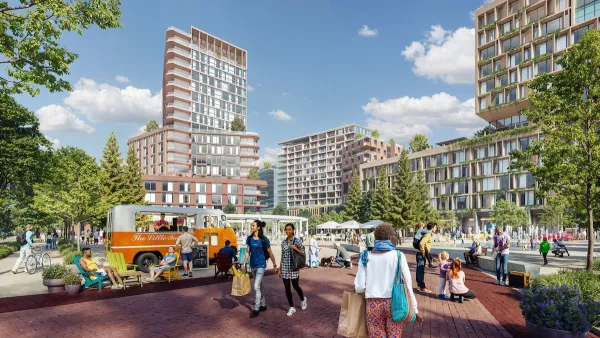
Mall and office park redevelopments are a generational opportunity to create new nodes of urbanity.

NYC breaks ground on anti-flooding infrastructure project
New York City's new system will reduce stormwater flows to local sewers by 90%.

One Kentucky town’s secret to affordable housing
The Smoketown Community Land Trust has already built seven affordable homes for community members.

Houston gains petal-shaped cooling infrastructure to make streets more ‘delightful’
The city has installed the pavilions along 15 blocks in Houston.

FREE Course: Walkable City 1: Why Walkability?
After describing his path towards focusing on walkability as the essence of good planning, Jeff Speck marches through his five principal reasons for making more walkable places.
Reinventing Malls: Planning Alchemy—Turning Gray Fields Into Gold
The course focuses on the opportunities and imperatives that shape reinvention of mall sites.

City of Rosemead
Rutgers University, Edward J. Bloustein School of Planning and Public Policy
One Hundred Miles
University of Michigan School for Environment and Sustainability (SEAS)
Hunter College, City University of New York (CUNY)
The Architects Foundation
City of Cambridge
Montrose County
The Pocatello Development Authority