People have been driving about 1% less per year for the last 9 years. What can public-private partnerships for transportation alternatives do to stoke this fire?


"Across America, too many people believe that 'no one will get out of their cars.' The newest data based on the American Community Survey, shows 'it ain’t so,' even for small cities and their surrounding areas. The national trend in the US is a drop of almost 1 percent per year in passenger vehicle-miles-traveled or VMT, driven by the high price of transportation generally and more specifically related to the need to drive, a function of the increased distance between people and what they do. People have been driving about 1% per year less for a while now."
Scott Bernstein, President of the Center for Neighborhood Technology, goes on to use Doña Ana County, New Mexico, as an example of the road to prosperity. Warning, this long thought piece is not an easy read, but sets out to invoke some heavy lifting for transportation types and PPPs.

Read the full story: The Road to Prosperity: Real-Time Approaches to Economic Improvement
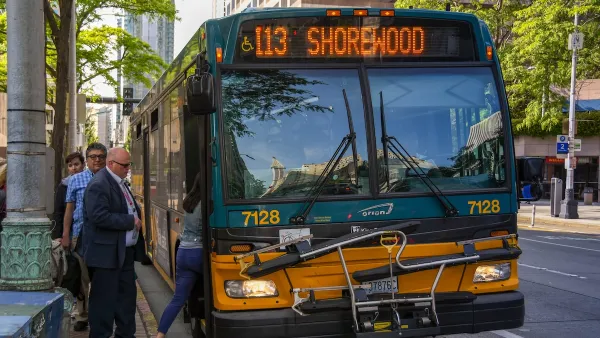
275,000 bus trips are at stake on Seattle's ballot
If passed, the Seattle Transit Measure would trigger a 0.3% sales tax and raise an average of $138 million per year to maintain and expand Seattle’s bus services.
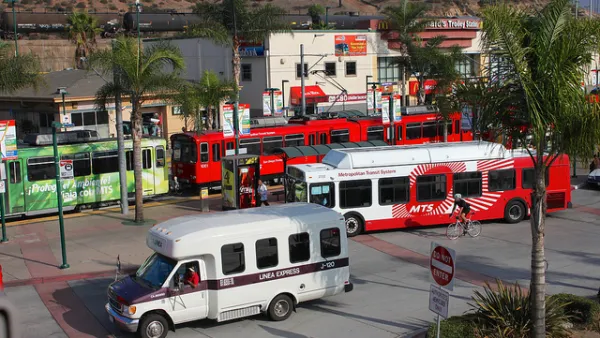
Transit Ridership Up in San Diego
Most of the U.S. saw public transit ridership continue its downward trend last year, but San Diego’s ridership, particularly on light rail, was up.
Can Jerusalem's Light Rail Pull the City’s Past Into the Future?
Since 2011, the controversial Jerusalem Light Rail system has been a driving force behind the renewal and reintegration of some areas of the old city. In addition, the Jerusalem Business District is being planned as the city's new economic hub.

Desperate measures: Advocates weigh draining Lake Powell to fill Colorado River
Draining the reservoir could reduce evaporation losses by a couple hundred thousand acre-feet.

Eastern Nebraska is running out of electricity
Data centers and electrification are straining eastern Nebraska’s grid, throttling economic development.

Malls are becoming the midtowns of the future
Mall and office park redevelopments are a generational opportunity to create new nodes of urbanity.

NYC breaks ground on anti-flooding infrastructure project
New York City's new system will reduce stormwater flows to local sewers by 90%.

One Kentucky town’s secret to affordable housing
The Smoketown Community Land Trust has already built seven affordable homes for community members.

Houston gains petal-shaped cooling infrastructure to make streets more ‘delightful’
The city has installed the pavilions along 15 blocks in Houston.

FREE Course: Walkable City 1: Why Walkability?
After describing his path towards focusing on walkability as the essence of good planning, Jeff Speck marches through his five principal reasons for making more walkable places.
Reinventing Malls: Planning Alchemy—Turning Gray Fields Into Gold
The course focuses on the opportunities and imperatives that shape reinvention of mall sites.

City of Rosemead
Rutgers University, Edward J. Bloustein School of Planning and Public Policy
One Hundred Miles
University of Michigan School for Environment and Sustainability (SEAS)
Hunter College, City University of New York (CUNY)
The Architects Foundation
City of Cambridge
Montrose County
The Pocatello Development Authority