Foreclosures, the defining signifier of the Great Recession for many Americans, are coming to a screeching halt in Colorado. In fact, the state’s foreclosure rate improved at about twice the national average between 2012 and 2013.


Aldo Svaldi reports on new data from RealtyTrac indicating the vastly improved state of the real estate market in Colorado: “Foreclosure activity in Colorado fell by 54 percent last year from 2012, with 16,684 homes, or 1 of every 132, at some stage of the foreclosure process.” New foreclosures in the state also produced good news, falling 58 percent.
For the sake of comparison, “U.S. homes in foreclosure fell by nearly 29 percent and the number of new foreclosure starts dropped by a third.”
Colorado has been performing well in other measures of prosperity too, showing well in a recent report about household wealth—one out of every 18 Colorado households has investable assets of $1 million or more.
Read the full story: Colorado foreclosures tumble in 2013

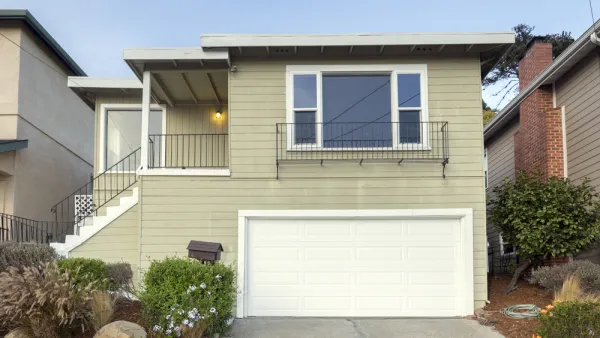
Starter Homes Are a Non-Starter
As prices rise, especially in desirable urban markets, what used to be called "starter homes" rarely come up for sale. And when they do, they go for more than first time home-buyers can afford.
On the Docket: Stabilizing Neighborhoods in Cleveland
Real estate speculators are being fined big bucks in Cleveland for letting properties sit vacant, but the jury's still out on whether this is the key to stabilizing neighborhoods.
Bank Doesn't Need Proof it Owns Your Mortgage to Foreclose in Colorado
Starting in 2002, the Colorado legislature began to make it easier to foreclose on properties in Colorado. Original loan documents are no longer required to prove the bank actually owns the property.

Planetizen Federal Action Tracker
A weekly monitor of how Trump’s orders and actions are impacting planners and planning in America.

Amtrak, CN end decades-long dispute with eight-year agreement
The new operating agreement establishes an updated framework for the companies to work together, including processes to resolve disputes.

Judges permit Denver to divert 77,000 acre feet from the Colorado River for reservoir expansion
Overuse and climate change have caused the Colorado River’s water levels to plummet.

NYC DOT wants faster, more permanent street upgrades
The city is examining ways to build more concrete infrastructure without getting entangled in 'decades-long' projects.

'Something we’ve never seen before:' rising utility rates could strain city finances nationwide
Data centers, climate change and other factors have caused utility rates in the United States to increase by 38% since 2020.

Trump to overrule local leaders, lease millions of acres of America’s Pacific Island territories’ seafloors to mining companies
International law says that the Indigenous people of America’s territories have a right to prior and informed consent regarding projects that impact their countries.

FREE Course: Walkable City 1: Why Walkability?
After describing his path towards focusing on walkability as the essence of good planning, Jeff Speck marches through his five principal reasons for making more walkable places.
Reinventing Malls: Planning Alchemy—Turning Gray Fields Into Gold
The course focuses on the opportunities and imperatives that shape reinvention of mall sites.

Harvard University Graduate School of Design
KFH Group Inc.
Greater Baltimore Committee
The Architects Foundation
University of Cincinnati Online
The Pocatello Development Authority
The Urban Renewal Agency of the City of Pocatello