Throughout North America's auto-oriented suburbs, front-facing garages are a common feature of home design. According to Brent Toderian, that design decision has a significant impact on speeding and the quality of neighborhoods.


"In suburbs all over North America, front garages are causing ripple effects that change the design and nature of our neighbourhoods in many ways that we don't initially realize," argues Toderian. By preventing on-street parking, and leaving extra-wide driving lanes, garages and driveways induce higher design speeds.
The impacts extend to the design and enjoyment of our neighborhoods as well, continues Toderian. "There likely isn't a sidewalk anyway. The curb cut usually replaces that, as well as the landscape strips, and street trees. Add to these losses the absence of on-street parking, which can be valuable as a buffer to separate pedestrians from moving cars, and you have a significant impact on the walkability of the neighbourhood."
Toderian suggests rear lanes as the best option for increasing safety and sociability.
Read the full story: How Your Garage Affects Speeding, Design In Your Neighbourhood
Flock cameras misread license plates in 71% of cases in California study
An analysis of 1,500 reports showed a shockingly high rate of error when reading license plates.
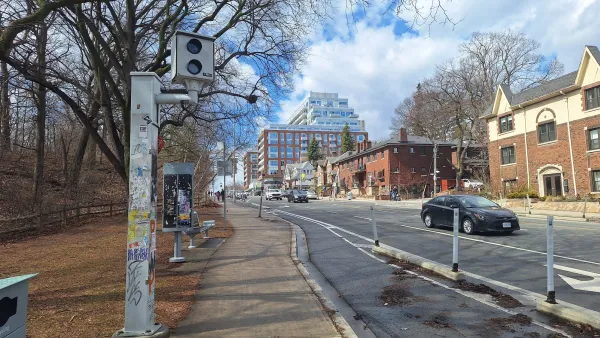
Speeding surges after Ontario cities remove traffic cameras
The province ordered cities to remove the devices despite data that shows they save lives.
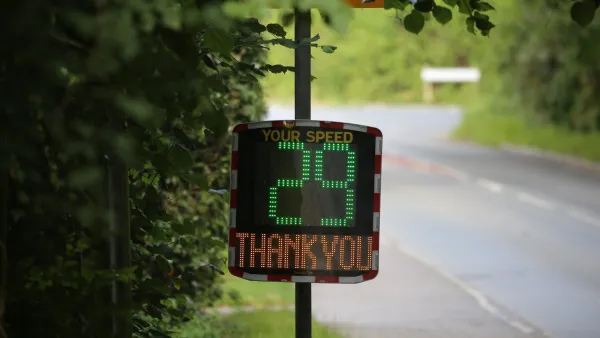
Austin road sign compliments safe drivers
An electronic display praises drivers who stay under the speed limit with personalized messages.

Planetizen Federal Action Tracker
A weekly monitor of how Trump’s orders and actions are impacting planners and planning in America.

California plans to bury El Niño’s downpour
If the state plays its cards right, it may be able to store a billion acre-feet of El Niño’s water in aquifers.

Desperate measures: Advocates weigh draining Lake Powell to fill Colorado River
Draining the reservoir could reduce evaporation losses by a couple hundred thousand acre-feet.

Los Angeles just elected an urban planner as its mayor
Transportation analysts are optimistic that Raman will be more aggressive in addressing transit issues than Bass.

Mamdani’s pied-à-terre tax survives legal challenge
A panel of judges found that the plaintiffs failed to demonstrate injury as a result of New York City's implementation of the tax.

Eastern Nebraska is running out of electricity
Data centers and electrification are straining eastern Nebraska’s grid, throttling economic development.

FREE Course: Walkable City 1: Why Walkability?
After describing his path towards focusing on walkability as the essence of good planning, Jeff Speck marches through his five principal reasons for making more walkable places.
Reinventing Malls: Planning Alchemy—Turning Gray Fields Into Gold
The course focuses on the opportunities and imperatives that shape reinvention of mall sites.

City of Rosemead
Rutgers University, Edward J. Bloustein School of Planning and Public Policy
One Hundred Miles
University of Michigan School for Environment and Sustainability (SEAS)
Hunter College, City University of New York (CUNY)
The Architects Foundation
City of Cambridge
Montrose County
The Pocatello Development Authority