Just about everything we screw up as individuals and organizations has to do with our determination to optimize both extremes of predictability and flexibility, writes Ben Brown


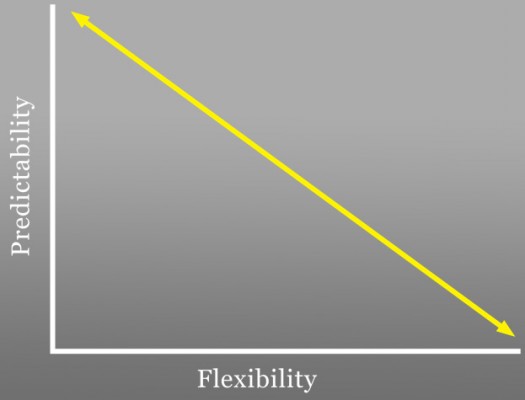
"Welcome to what we all need: A single chart that explains everything. Okay, maybe not everything. But a lot of stuff, especially stuff related to making rules for growing businesses and communities."
"It’s simple. And here’s what it illustrates: When you’re shaping rules to live by, the more you optimize flexibility, the more you sacrifice predictability. The higher you prioritize predictability, the lower your chances for flexibility."
Brown goes on with an extensive thought piece on how this applies to life ... and planning. He tells the nuanced story of the various types of urbanism -- lean in the far corner of flexibility and full codification of urbanism and architecture in the far corner of predictability. To be resilient, can we put all our eggs in either basket?
Read the full story: One Chart to Explain Everything: You’re welcome


Lessons from the Pandemic: Housing, Retail, Broadband
Second in a series of conversations about what comes next in local government policies and processes, this time between Geoff Koski and Ben Brown on housing, retail, and broadband

After the Plague: Go Big or Go Backwards?
Among unwelcome lessons of COVID-19 is growing evidence of what was already broken in politics and business. Ben Brown looks at making bold changes in order to improve the lives of the left out and left behind.

Plotting a Persuasive Story? Better Have a Happily Ever After
All stories are purposeful. They’re meant to entertain or inform or inspire to action. If you're a storyteller for a placemaking initiative, Ben Brown says you'd better have a happily ever after.

Planetizen Federal Action Tracker
A weekly monitor of how Trump’s orders and actions are impacting planners and planning in America.

California plans to bury El Niño’s downpour
If the state plays its cards right, it may be able to store a billion acre-feet of El Niño’s water in aquifers.

Chicago breaks ground on $3 billion megadevelopment
The new neighborhood, titled Foundry Park, will one day host 3,700 residences.

Want to study the Missouri River? Soon, you may need unanimous approval from 10 states
Legislation would require 10 governors’ permission to study or build projects moving water outside the basin.

Desperate measures: Advocates weigh draining Lake Powell to fill Colorado River
Draining the reservoir could reduce evaporation losses by a couple hundred thousand acre-feet.

This road in NYC is infamously dangerous — and Mamdani can't fix it
New York City's Ocean Parkway is known for reckless driving, but the power to implement safety measures lies with the state rather than the city.

FREE Course: Walkable City 1: Why Walkability?
After describing his path towards focusing on walkability as the essence of good planning, Jeff Speck marches through his five principal reasons for making more walkable places.
Reinventing Malls: Planning Alchemy—Turning Gray Fields Into Gold
The course focuses on the opportunities and imperatives that shape reinvention of mall sites.

City of Rosemead
Rutgers University, Edward J. Bloustein School of Planning and Public Policy
One Hundred Miles
Hunter College, City University of New York (CUNY)
The Architects Foundation
University of Cincinnati Online
City of Cambridge
Montrose County
The Pocatello Development Authority