Paul Salopek is embarking on a 21,000-mile, 7-year stroll around the world. After traversing 1,700 miles, his most profound insights focus on the impact of the century-old automotive revolution on our psyche - what he calls "Car Brain".


"The 'Out of Eden Walk,' as I’m calling it, uses deep history as a mirror for current events," explains Salopek. "But even as I adhere strictly to my brand of bipedal journalism, trying as it were to put myself in a Pleistocene state of mind, cars keep roaring into my awareness. They are inescapable. They are without a doubt the defining artifacts of our civilization. They have reshaped our minds in ways that we long ago ceased thinking about."
"I have nothing personal against motorized travel. Cars build middle classes. They grant us undreamed-of freedom. And I suspect that I’ll be driving away from my walk’s end point in Chile in 2020. But it’s probably inevitable that, as I plod through the Middle East, Asia and the Americas over the next six years, I’ll become increasingly alienated from the growing bulk of humanity afflicted by Car Brain."
Read the full story: A Stroll Around the World

Study reveals best places in the U.S. for cycling, walking
New research from Streetlight Data examines bicycle and pedestrian miles per capita in the 100 largest U.S. cities by population.
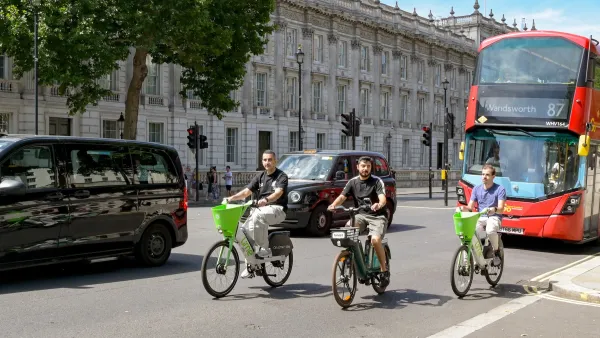
Bike use in London grew by 43% since 2019, but car use remains roughly the same
The city's efforts to reduce car use have stalled despite ambitious programs like congestion pricing and low-traffic neighborhoods.
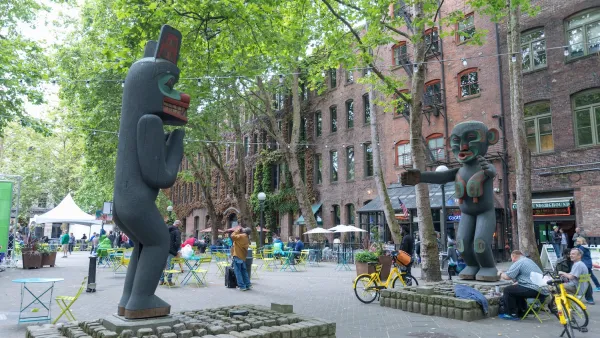
Seattle's Pioneer Square to become pedestrian zone during World Cup
The city will restrict car traffic and street parking in areas around Lumen Field on match days.

Desperate measures: Advocates weigh draining Lake Powell to fill Colorado River
Draining the reservoir could reduce evaporation losses by a couple hundred thousand acre-feet.

Eastern Nebraska is running out of electricity
Data centers and electrification are straining eastern Nebraska’s grid, throttling economic development.

Malls are becoming the midtowns of the future
Mall and office park redevelopments are a generational opportunity to create new nodes of urbanity.

NYC breaks ground on anti-flooding infrastructure project
New York City's new system will reduce stormwater flows to local sewers by 90%.

One Kentucky town’s secret to affordable housing
The Smoketown Community Land Trust has already built seven affordable homes for community members.

Houston gains petal-shaped cooling infrastructure to make streets more ‘delightful’
The city has installed the pavilions along 15 blocks in Houston.

FREE Course: Walkable City 1: Why Walkability?
After describing his path towards focusing on walkability as the essence of good planning, Jeff Speck marches through his five principal reasons for making more walkable places.
Reinventing Malls: Planning Alchemy—Turning Gray Fields Into Gold
The course focuses on the opportunities and imperatives that shape reinvention of mall sites.

City of Rosemead
Rutgers University, Edward J. Bloustein School of Planning and Public Policy
One Hundred Miles
University of Michigan School for Environment and Sustainability (SEAS)
Hunter College, City University of New York (CUNY)
The Architects Foundation
City of Cambridge
Montrose County
The Pocatello Development Authority