New York's lengthy waterfront was once dotted with an extensive array of piers, reaching like tentacles from the city's shores into the surrounding harbor and rivers. As the city again embraces its waterfront, those that remain are getting new life.


"Historical maps and old aerial photographs show New York’s shores wrapped with piers reaching out into the water to connect the streets and businesses of a port city to the world," observes Daniel Rojo. "Though many of those piers have long since disappeared, those that remain are being recognized as a significant resource for public (and semi-public) use and many are being transformed into sites of leisure, practice, production, and exposition."
Rojo goes on to explore current and future plans for transforming seven of these relics into event spaces, restaurants, parks, shops, and an "office/incubator space for 'creative companies'".
Read the full story: New Lives for Old Piers

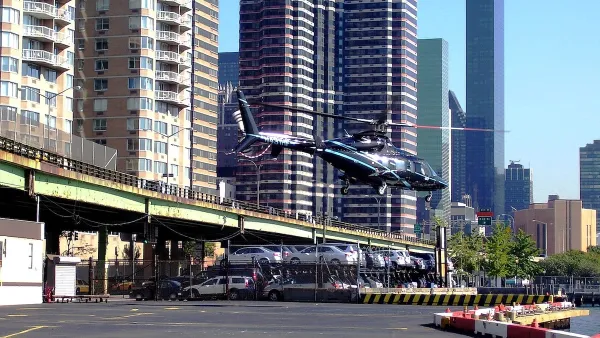
Manhattan Waterfront Parking Lot to Become Public Park
A lot that has served as parking for decades will add a much-needed public amenity to the East River waterfront.
Planning for New York's "Sixth Borough"
A year after its release, Tom Stoelker tracks the progress of New York's comprehensive plan for its waterfront, Vision 2020, the recent recipient of the APA's Daniel Burnham Award.
U.N. Land Deal Could Fund NYC Esplanade
Pending a memorandum of understanding between city and U.N. officials, Manhattan may begin a land swap process that will finally fill in a mile-long gap of greenway along the East River. Lisa R. Foderaro reports.

Planetizen Federal Action Tracker
A weekly monitor of how Trump’s orders and actions are impacting planners and planning in America.

Chicago breaks ground on $3 billion megadevelopment
The new neighborhood, titled Foundry Park, will one day host 3,700 residences.

This MA town is drowning in its own sewage — and residents like it that way
Susan Murcott, a waste water expert, said if Carlisle didn't address their leaking sewage, the problem could turn “deadly.”

Iowa taxpayers are paying thousands to clean manure out of their water
While the Clean Water Act makes states responsible for regulating factory farms that discharge pollutants, Iowa has turned a blind eye to the polluting farms.

Amtrak cuts ribbon on Seattle Airo maintenance facility
The $250 million, nearly 100,000-square-foot building can house an entire Cascades Airo trainset.

To power data centers, Google seeks autonomous control of thousands of homes’ electricity
The tech company has signed a deal to indirectly pay Mid-Atlantic residents to reduce their power demand when the grid is strained.

FREE Course: Walkable City 1: Why Walkability?
After describing his path towards focusing on walkability as the essence of good planning, Jeff Speck marches through his five principal reasons for making more walkable places.
Reinventing Malls: Planning Alchemy—Turning Gray Fields Into Gold
The course focuses on the opportunities and imperatives that shape reinvention of mall sites.

City of Rosemead
Rutgers University, Edward J. Bloustein School of Planning and Public Policy
One Hundred Miles
The Architects Foundation
University of Cincinnati Online
Montrose County
The Pocatello Development Authority
The Urban Renewal Agency of the City of Pocatello