As one of the world's most respected voices on climate change prepares the final draft of its latest report on the warming planet, a debate is playing out behind the scenes as to whether it is intentionally downplaying the potential impacts.


As the U.N.'s Nobel Peace Prize winning Intergovernmental Panel on Climate Change prepares to release its latest report at the end of the month, Justin Gillis looks at "two big fights" that are brewing over mainstream and outlier predictions of future sea level and temperature increases.
"Climate change skeptics often disparage these periodic reports from the United Nations, claiming that the panel writing them routinely stretches the boundaries of scientific evidence to make the problem look as dire as possible. So it is interesting to see that in these two important cases, the panel seems to be bending over backward to be scientifically conservative," he observes.
"Is it right to throw out bleeding-edge science in the one case while keeping it in the other? That is hard to judge for anybody who is not a working climate scientist."
Read the full story: A Climate Alarm, Too Muted for Some

Three Feet of Sea Level Rise Very Possible by Century's End
A preview of the next major United Nations climate change report is taking a stronger stance on the role of humans in causing global warming and predicting a possible sea level rise that would endanger cities such as London, New York, and Shanghai.
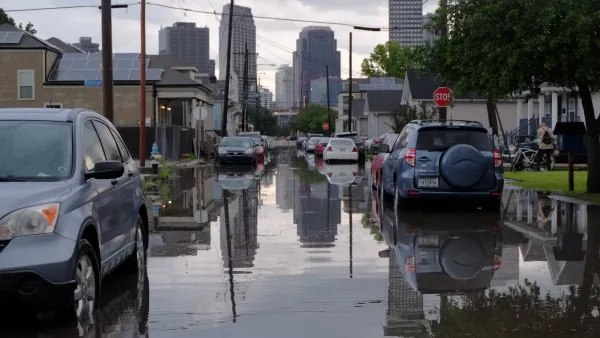
Study: New Orleans sea level rise is at 'point of no return'
Research shows that the city could be surrounded by water by the end of this century.
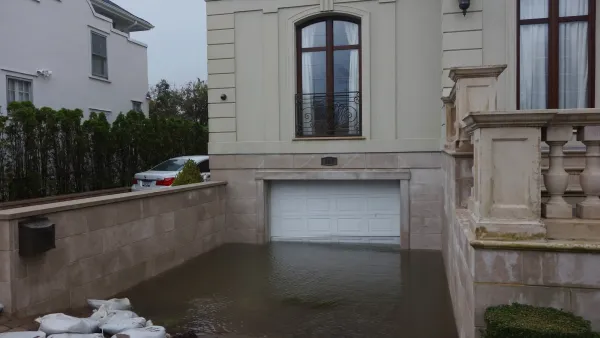
Over 500 NYC ‘Blue Zones’ at Risk of More Destructive Floods
High-risk flood zones cover roughly 20% of the city’s land.

Planetizen Federal Action Tracker
A weekly monitor of how Trump’s orders and actions are impacting planners and planning in America.

Amtrak, CN end decades-long dispute with eight-year agreement
The new operating agreement establishes an updated framework for the companies to work together, including processes to resolve disputes.

Judges permit Denver to divert 77,000 acre feet from the Colorado River for reservoir expansion
Overuse and climate change have caused the Colorado River’s water levels to plummet.

Atlanta City Council unanimously backs $3.5 billion Beltline light rail project
The resolution was drafted after Atlanta Mayor Andre Dickens pulled support for the Atlanta Streetcar extension last year.

SEPTA to bring nearby frequent transit to over 1 million new riders as part of decade-long plan
The agency's Accelerate plan will also bring frequent transit to twice the amount of jobs that are currently located near it.

NYC plants over 18,000 trees, the most new foliage in a decade
Many of the trees were planted in communities vulnerable to extreme heat.

FREE Course: Walkable City 1: Why Walkability?
After describing his path towards focusing on walkability as the essence of good planning, Jeff Speck marches through his five principal reasons for making more walkable places.
Reinventing Malls: Planning Alchemy—Turning Gray Fields Into Gold
The course focuses on the opportunities and imperatives that shape reinvention of mall sites.

City of Thousand Oaks
City of Wisconsin Rapids
Harvard University Graduate School of Design
The Architects Foundation
University of Cincinnati Online
The Pocatello Development Authority
The Urban Renewal Agency of the City of Pocatello