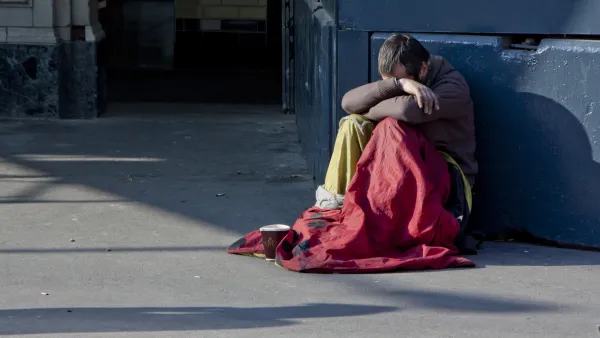
Despite a deep recession driven by a housing bust, the National Alliance to End Homelessness estimates that homelessness dropped by 17 percent from 2005 to 2012. This is astonishing news, right? So why aren't politicians trumpeting this decline?



From President George W. Bush’s "housing first" program to President Obama's Homeless Prevention and Rapid Re-Housing Program, federal initiatives have been remarkably successful in reducing homelessness. "The decline of homelessness over the past eight years is nothing short of a blue-moon public policy triumph," writes Stephen Lurie. "Why don’t you know about it?"
"Could it be because we’d prefer not to hear about it?" he asks. "In the next few years, as Washington looks to cut spending across the board, the public’s aversion to homelessness could contribute to its return."
"As quietly as homelessness has fallen, so too it will go up quietly – unless there is major intervention," Lurie cautions. "The United States Department of Housing and Urban Development estimates that sequestration cuts from homelessness programs are set to expel 100,000 people from a range of housing and shelter programs this year. That’s nearly one sixth of the current total homeless population. Far from gently raising the homeless rate, it would undo a full decade of progress."
Read the full story: The Astonishing Decline of Homelessness in America
Seattle's Homeless Population Is Booming Too
While rates of homelessness drop elsewhere, tents and cardboard are becoming a very regular sight in Seattle. New wealth and newly unaffordable housing may be twin culprits.
Supreme Court to Review EPA's Mercury Standard
The top court's decision on Tuesday to review the first-ever regulation of mercury is a setback for Obama's environmental agenda, in part because it has implications for other EPA initiatives including Wednesday's proposal to tighten the ozone rule.
Did Obama Bet on the Wrong Electric Vehicle Technology?
With Toyota's long-waited fuel cell electric vehicle (FCV) hitting showrooms in the U.S. this week, Kenneth Chang, science reporter for The New York Times, delves further into the technology, starting with how it fared under two administrations.

Planetizen Federal Action Tracker
A weekly monitor of how Trump’s orders and actions are impacting planners and planning in America.

California plans to bury El Niño’s downpour
If the state plays its cards right, it may be able to store a billion acre-feet of El Niño’s water in aquifers.

Desperate measures: Advocates weigh draining Lake Powell to fill Colorado River
Draining the reservoir could reduce evaporation losses by a couple hundred thousand acre-feet.

US buildings threatened, destroyed by fires set to triple by 2060
Researchers found a high fire risk for socioeconomically vulnerable neighborhoods in the American West.

LA residents may be allowed to paint their own crosswalks
Councilwoman Katy Yaroslavsky put out a motion instructing the Los Angeles Department of Public Transportation to study the feasibility of allowing volunteers to paint crosswalks.

Dallas moves to overhaul its zoning code
The city's zoning reform will allow more multi-family and mixed-use developments.

FREE Course: Walkable City 1: Why Walkability?
After describing his path towards focusing on walkability as the essence of good planning, Jeff Speck marches through his five principal reasons for making more walkable places.
Reinventing Malls: Planning Alchemy—Turning Gray Fields Into Gold
The course focuses on the opportunities and imperatives that shape reinvention of mall sites.

City of Rosemead
Rutgers University, Edward J. Bloustein School of Planning and Public Policy
One Hundred Miles
Hunter College, City University of New York (CUNY)
The Architects Foundation
University of Cincinnati Online
City of Cambridge
Montrose County
The Pocatello Development Authority