A year after the city staged an Olympic games intended to provide a legacy of revitalization for East London, Oliver Wainwright checks in on the progress. While the early results are 'not auspicious', he still finds reason for optimism.


"Presented as a benevolent behemoth of fast-track regeneration, the Games were supposed to leave behind a shiny new world of 12,000 homes and 10,000 jobs, set amid the rolling hills of the largest new park in Europe. It would be the miracle cure for the maligned East End, cleansing a swath of the Lower Lea valley – a site conveniently branded as a toxic dumping ground, at the nexus of London's poorest boroughs."
"Walking down Stratford High Street, along the south-east border of the Olympic park, the signs are not auspicious," Wainwright observes. "At every junction of this roaring A-road sprouts a steroidal tower, each clad in ever more lurid colours, transforming the street into a gauntlet of competing ambitions. Looming over adjacent council estates, these brash totems are a monument to Olympian greed."
However, he continues, "Despite all the blunders around the edge of the site, there are reasons to be optimistic. The communities within could yet be successful. But an uneasy fact remains: that building on the site of a global event – making workable streets from tarmac wastes and weaving housing around velodromes – is a difficult and expensive way of producing a good city."
Read the full story: London's Olympics legacy faces early disqualification
Soccer Teams Battle Over Future Legacy of London Olympic Stadium
Two soccer teams in England are in the midst of a battle over who will take over the stadium being built for the 2012 Olympics in London. They're arguing over who will leave the better legacy.
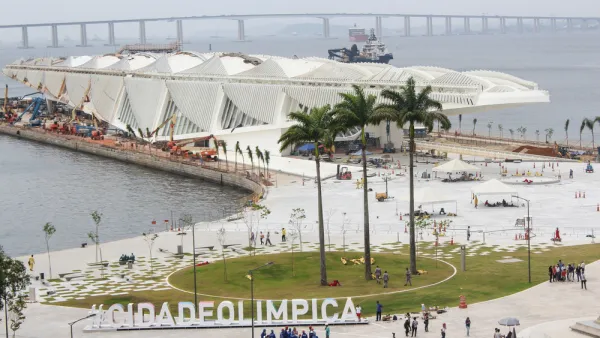
Abandoned Olympic Venues Cast Doubt on the Value of Hosting
Though cities hope for an economic boost, these photos show it's far from guaranteed.
Only Six Months After the Games, London's Olympic Legacy in Doubt
The failure to secure a full-time tenant for the Olympic Stadium, the centerpiece of London's Olympic Park, has cast doubt on one of the selling points of the city's Olympic bid - its post-games impact.

Planetizen Federal Action Tracker
A weekly monitor of how Trump’s orders and actions are impacting planners and planning in America.

California plans to bury El Niño’s downpour
If the state plays its cards right, it may be able to store a billion acre-feet of El Niño’s water in aquifers.

Desperate measures: Advocates weigh draining Lake Powell to fill Colorado River
Draining the reservoir could reduce evaporation losses by a couple hundred thousand acre-feet.

Los Angeles just elected an urban planner as its mayor
Transportation analysts are optimistic that Raman will be more aggressive in addressing transit issues than Bass.

Mamdani’s pied-à-terre tax survives legal challenge
A panel of judges found that the plaintiffs failed to demonstrate injury as a result of New York City's implementation of the tax.

Eastern Nebraska is running out of electricity
Data centers and electrification are straining eastern Nebraska’s grid, throttling economic development.

FREE Course: Walkable City 1: Why Walkability?
After describing his path towards focusing on walkability as the essence of good planning, Jeff Speck marches through his five principal reasons for making more walkable places.
Reinventing Malls: Planning Alchemy—Turning Gray Fields Into Gold
The course focuses on the opportunities and imperatives that shape reinvention of mall sites.

City of Rosemead
Rutgers University, Edward J. Bloustein School of Planning and Public Policy
One Hundred Miles
University of Michigan School for Environment and Sustainability (SEAS)
Hunter College, City University of New York (CUNY)
The Architects Foundation
City of Cambridge
Montrose County
The Pocatello Development Authority