Wasn't the era of the shopping mall supposed to be over? City Creek Center, the retractable roof-topped luxury shopping center financed by the Church of Jesus Christ of Latter-day Saints, is being credited with breathing new life into Salt Lake City.


"[City Creek Center], which opened a little more than a year ago, is the centerpiece of a mixed-use development that was financed entirely by the [Mormon] church, which spent, by any estimate, hundreds of millions of dollars," reports Caitlin Kelly. "Although the combination of commerce and religion in this case may seem unusual, business leaders and developers credit the mall with spurring new business and enlivening what had been the faded core of Salt Lake City, home to 189, 900."
"The 'mall is the single most important thing to happen to Salt Lake City in 50 years, maybe more,' said Bruce Bingham, a partner with Hamilton Partners, a Chicago-based real estate developer. 'It revitalized downtown.'”
The church-financed mall isn't without its critics however. "Derek Staffanson, 39, a Mormon and a local resident, said he had mixed feelings about the mall project. 'In theory, I find nothing wrong with the idea of a religious institution developing the area,' he said. 'Churches have a long history of contributing to the civic amenities of their communities.'”
“But in practice, I’m very disappointed with the manner in which the L.D.S. church chose to develop the area, the use to which they put it, and what that implies about the church’s priorities,” Mr. Staffanson said. “If they had really been concerned about the local community and ending the blight, they would have built a mixed-income, mixed-use community, focusing on developing local entrepreneurship, community centers and resources, a playground, more like the true walkable urban communities in Europe. That would have truly revitalized the local community, creating more prosperity for all.
“For this huge sum of money to be spent on an edifice for commerce and conspicuous consumption seems at best misguided.”
Read the full story: Mormon-Backed Mall Breathes Life into Salt Lake City
Mixed-Use for Mormons
A private development of the Church of Jesus Christ of Latter-day Saints, City Creek Center will be the largest mixed-use project in Salt Lake City.
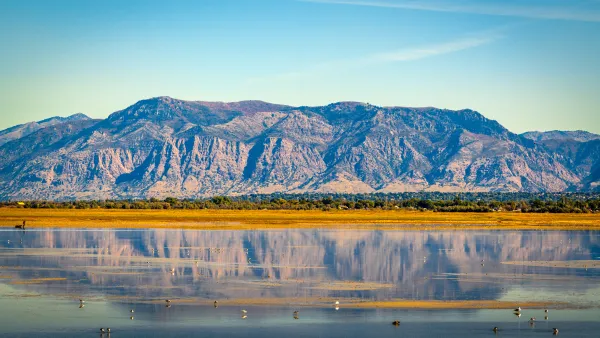
Feds look to Great Salt Lake as a source of rare minerals
A new grant is funding the expansion of non-evaportative lithium extraction from the brackish waters.

‘Snow-eater’ heat waves are increasing in frequency, study finds
During intense spring heatwaves, snow melts nearly twice as fast as usual and can overwhelm city reservoirs.

Desperate measures: Advocates weigh draining Lake Powell to fill Colorado River
Draining the reservoir could reduce evaporation losses by a couple hundred thousand acre-feet.

Eastern Nebraska is running out of electricity
Data centers and electrification are straining eastern Nebraska’s grid, throttling economic development.

Move over, LA: St. Louis gears up for Olympics, invests millions in downtown redevelopment
The Missouri city will host the 2028 Olympic soccer group stage and knockout matches.

Mass. votes against statewide minimum lot size for single-family homes
Over 2 million residents voted on Question 7; it was decided by just over 30,000 votes.

Maryland’s $15 billion bridge project gains key approval
The Maryland Transit Authority said the project will create over 60,000 jobs and add $23 billion to the local economy.

‘No clear next steps’ for Chicago's permanent festival grounds
Eleventh Ward Ald. Nicole Lee has suggested Soldier Field as a possible location for the permanent event space.

FREE Course: Walkable City 1: Why Walkability?
After describing his path towards focusing on walkability as the essence of good planning, Jeff Speck marches through his five principal reasons for making more walkable places.
Reinventing Malls: Planning Alchemy—Turning Gray Fields Into Gold
The course focuses on the opportunities and imperatives that shape reinvention of mall sites.

City of Rosemead
Rutgers University, Edward J. Bloustein School of Planning and Public Policy
One Hundred Miles
University of Michigan School for Environment and Sustainability (SEAS)
Hunter College, City University of New York (CUNY)
The Architects Foundation
City of Cambridge
Montrose County
The Pocatello Development Authority