While many cities are seeking to build large entertainment venues to revive their downtowns, St. Petersburg is taking the opposite track. Stephen Nohlgren examines whether Tropicana Field can be the city's next big urban mixed use development.


"Thirty years ago, St. Petersburg took a leap of civic faith when it leveled a low-income neighborhood to attract a baseball team," writes Nohlgren. "Now Tropicana Field's 85 asphalt acres offer another chance for neighborhood rehabilitation — this time without baseball."
The national trend towards dense mixed-use development has arrived in this coastal Florida city, with developers and real estate experts eying the aging home of the Tampa Bay Rays baseball team as an ideal site for redevelopment. "It's not very common to be able to put together that large a site for a master planned project anywhere in a desirable area like Florida,'' Larry Richey, managing director of Cushman & Wakefield said. "It's a special place.''
"The Tampa Bay Rays, wanting a new stadium elsewhere, have begun to tout the Trop's redevelopment potential as more valuable to the city than baseball," notes Nohlgren. "The city 'is sitting on an enormous piece of land in a rapidly growing downtown that is, frankly, lying fallow,'' Rays vice president Michael Kalt recently told the Pinellas County Commission."
"The remaining debt on the stadium 'pales in comparison to what can come from property and sales tax generation if you put that land to use,' he said."
Read the full story: Tropicana Field: The next big urban mixed use development?
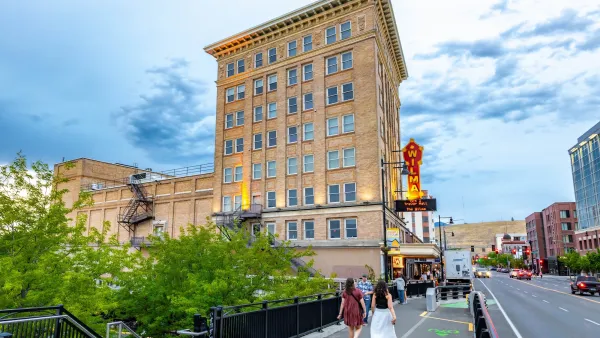
Missoula Approves Zoning Reform Emphasizing More Diverse Housing, Walkability
The city’s new zoning code, map, and development standards will guide more expansive housing options and improved walkability.
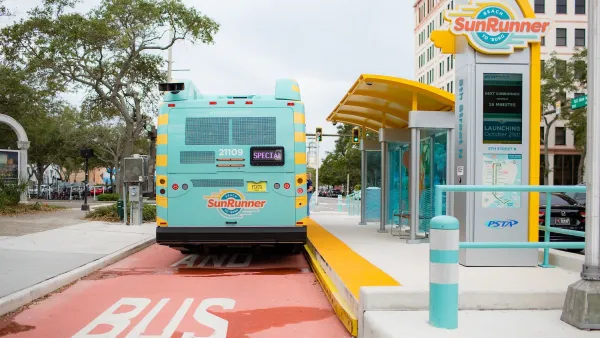
Lawsuit Claims Florida Bus Lane Removal was Illegal
The state cites an increase in crashes and congestion as reasons for eliminating a dedicated bus lane on the SunRunner BRT line, but city data tells a different story.

NYC's Plan to add 9500+ Housing Units to Midtown
The city council approved a rezoning plan that will allow high-density mixed-use development in a formerly manufacturing-only district.

Planetizen Federal Action Tracker
A weekly monitor of how Trump’s orders and actions are impacting planners and planning in America.

California plans to bury El Niño’s downpour
If the state plays its cards right, it may be able to store a billion acre-feet of El Niño’s water in aquifers.

Desperate measures: Advocates weigh draining Lake Powell to fill Colorado River
Draining the reservoir could reduce evaporation losses by a couple hundred thousand acre-feet.

Los Angeles just elected an urban planner as its mayor
Transportation analysts are optimistic that Raman will be more aggressive in addressing transit issues than Bass.

Mamdani’s pied-à-terre tax survives legal challenge
A panel of judges found that the plaintiffs failed to demonstrate injury as a result of New York City's implementation of the tax.

Eastern Nebraska is running out of electricity
Data centers and electrification are straining eastern Nebraska’s grid, throttling economic development.

FREE Course: Walkable City 1: Why Walkability?
After describing his path towards focusing on walkability as the essence of good planning, Jeff Speck marches through his five principal reasons for making more walkable places.
Reinventing Malls: Planning Alchemy—Turning Gray Fields Into Gold
The course focuses on the opportunities and imperatives that shape reinvention of mall sites.

City of Rosemead
Rutgers University, Edward J. Bloustein School of Planning and Public Policy
One Hundred Miles
University of Michigan School for Environment and Sustainability (SEAS)
Hunter College, City University of New York (CUNY)
The Architects Foundation
City of Cambridge
Montrose County
The Pocatello Development Authority