On Friday, New York City announced yet another postponement for the launch of its long-awaited bike-share program. While faulty software was reportedly the cause for the initial delay, Superstorm Sandy can be blamed for the most recent problems.


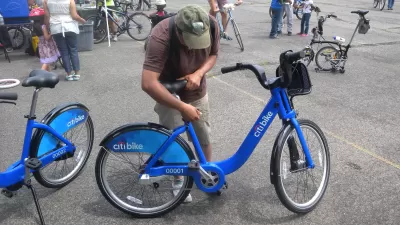
As we learned last month, New York's bedeviled bike-share program was victimized by Superstorm Sandy when its storage facility at the Brooklyn Navy Yard was flooded. Now that the city's Transportation Department has had an opportunity to tally the damage, they've announced that "bike share will now begin in May...and on a smaller scale than originally planned," reports Matt Flegenheimer.
"In August, the city said the program would initially feature 7,000 bikes at 420 stations by March, then expand to 10,000 bikes and 600 stations by this summer. Now, the plan is to have at least 5,500 bikes at 293 stations by May. There is no timeline for the program to expand to 10,000 bikes."
"Janette Sadik-Khan, the city’s transportation commissioner, said she was pleased that a spring opening was still expected, given the scope of the storm’s damage," writes Flegenheimer. "The system’s pieces are weather-proof, 'but they’re not intended to be totally submerged in salt water baths,' she said, adding, 'We’ve literally had to open every piece of equipment with a transistor or a circuit board to see what the damage is.'”
Read the full story: Newly Delayed Bike Share Program Is Now to Begin in May
U.S. Bike Share: 23 Million Rides; Zero Fatalities
Despite all the dire—sometimes hysterical—warnings about the safety risks of bike share, the country's bike share systems boast a flawless fatality record. Compare that record with, for instance, driving or riding non-bike-share bikes.

A Different Kind of Bike Share Story: Closing Down
We've posted stories here about many bike share programs opening up, or being proposed, throughout the U.S. (as well as internationally). Sadly, not all programs succeed or continue, particularly when they are pilots, as is the case in Hoboken, N.J..
Station Fail: Citi Bike's Major Malfunction
Software problems delayed the launch of New York City's bike share program for nearly a year. Now that the system has launched, technical problems persist. Will they threaten its success?

Planetizen Federal Action Tracker
A weekly monitor of how Trump’s orders and actions are impacting planners and planning in America.

Eastern Nebraska is running out of electricity
Data centers and electrification are straining eastern Nebraska’s grid, throttling economic development.

Study reveals best places in the U.S. for cycling, walking
New research from Streetlight Data examines bicycle and pedestrian miles per capita in the 100 largest U.S. cities by population.

Federal government nominates new FTA administrator
Mark Aesch is currently the founder and CEO of a transportation management consulting firm.

Developers reveal $10 billion stadium plan as ‘Hail Mary’ to keep Bears in Chicago
The plan would also boast a public park, high- and mid-rise buildings and a youth sports complex.

As Texas embraces carbon storage, a Black community questions the risks
Texas now issues permits for companies to store carbon dioxide underground. East Texas residents fear safety risks, and skeptics doubt the climate benefits.

FREE Course: Walkable City 1: Why Walkability?
After describing his path towards focusing on walkability as the essence of good planning, Jeff Speck marches through his five principal reasons for making more walkable places.
Reinventing Malls: Planning Alchemy—Turning Gray Fields Into Gold
The course focuses on the opportunities and imperatives that shape reinvention of mall sites.


City of Charlotte
City of Rosemead
Rutgers University, Edward J. Bloustein School of Planning and Public Policy
University of Michigan School for Environment and Sustainability (SEAS)
Hunter College, City University of New York (CUNY)
The Architects Foundation
City of Cambridge
The Pocatello Development Authority
The Urban Renewal Agency of the City of Pocatello