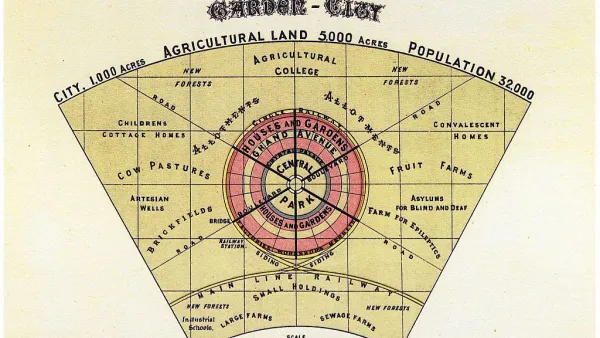
A new exhibit that opened this week at the San Francisco Planning and Urban Research Association's gallery explores the 10 diagrams that have had a monumental influence on urban planning, and the possibilities inherent in the medium.


Emily Badger surveys the 10 highly influential diagrams - from Ebenezer Howard's Garden City to Le Corbusier's Radiant City to the Transect - that comprise SPUR's new exhibition, "Grand Reductions: Ten diagrams that changed urban planning." She also examines the possibilities, both positive and negative, inherent in a "simple illustration's power to encapsulate complex ideas."
"In the urban context, diagrams can be powerful precisely because they
make weighty questions of land use and design digestible in a single
sweep of the eye," notes Badger. "But as Le Corbusier's plan illustrates, they can also
seductively oversimplify the problems of cities."
"The diagram can cut both ways: It can either be a distillation in the
best sense of really taking a very complex set of issues and providing
us with a very elegant communication of the solution," says Benjamin Grant, the public realm and urban design program manager for SPUR. "Or
it can artificially simplify something that actually needs to be
complex."
The exhibit is on show until February 15, 2013 at the SPUR Urban Center Gallery, 654 Mission Street, San Francisco.
Read the full story: The Evolution of Urban Planning in 10 Diagrams

The Evolution of Green Urbanism
Today’s "Eco" or "Green" Urbanism movement has ancient, cross-cultural roots. This history is worth contemplating for lessons relevant to sustainable planning and design.
Are Garden Cities Sustainable?
The Garden City concept has a long and honorable pedigree within urban planning. Analysis of Sterling Ranch, a master-planned community outside of Denver, Colorado highlights some important issues around social and environmental sustainability.

Clash Over Garden City Apartments in Los Angeles
The Wyvernwood Garden Apartments, a large-scale low-rise development opened in 1939, are at the center of a preservation debate. Lauren Walser gives us the case for keeping them.

Planetizen Federal Action Tracker
A weekly monitor of how Trump’s orders and actions are impacting planners and planning in America.

Eastern Nebraska is running out of electricity
Data centers and electrification are straining eastern Nebraska’s grid, throttling economic development.

Study reveals best places in the U.S. for cycling, walking
New research from Streetlight Data examines bicycle and pedestrian miles per capita in the 100 largest U.S. cities by population.

DSA members accuse Mamdani of 'abandoning values' over housing redevelopment
New York City's mayor plans to replace about 2,000 units of public housing with private, mixed-income housing.

All sides of BRT debate unhappy with CDOT’s most recent move
The Colorado Department of Transportation is no longer considering center-running bus lanes for Colorado Boulevard.

Massachusetts bogs generate both power, and cranberries
Putting solar panels above farmland is one way Massachusetts is advancing toward its goal of net-zero carbon emissions by 2050.

FREE Course: Walkable City 1: Why Walkability?
After describing his path towards focusing on walkability as the essence of good planning, Jeff Speck marches through his five principal reasons for making more walkable places.
Reinventing Malls: Planning Alchemy—Turning Gray Fields Into Gold
The course focuses on the opportunities and imperatives that shape reinvention of mall sites.

City of Rosemead
Rutgers University, Edward J. Bloustein School of Planning and Public Policy
One Hundred Miles
University of Michigan School for Environment and Sustainability (SEAS)
Hunter College, City University of New York (CUNY)
The Architects Foundation
City of Cambridge
The Pocatello Development Authority
The Urban Renewal Agency of the City of Pocatello