A new report from the League of American Bicyclists highlights studies from across the U.S. showing the economic benefits of biking.


"This report highlights the impact the bicycle industry and bicycle tourism can have on state and local economies, discusses the cost effectiveness of investments, points out the benefits of bike facilities for business districts and neighborhoods, and identifies the cost savings associated with a mode shift from car to bicycle", writes Darren Flusche, Policy Director of the League of American Bicyclists, in the 24-page report.
In addition to the report, the League published a compelling graphic highlighting studies from across the country showing the positive benefits: "You can see, for example, that bike recreation and tourism contributes an estimated $924 million a year to Wisconsin, plus $409 million in health benefits. Or that biking generates $400 million for Iowa, according to the University of Northern Iowa, and the Iowa Bicycle Coalition. Or that bike tourism brings in $60 million for North Carolina's Outer Banks area," writes Ben Schiller of Co.Exist.
Read the full story: Bikes Aren’t Just Good For You, They’re Good For The Economy, Too
What's the Value of Bicycling? $1.5 Billion, in Wisconsin
A new study by the Nelson Institute for Environmental Studies at the University of Wisconsin-Madison found that bicycling contributes $1.5 billion to Wisconsin's economy every year.
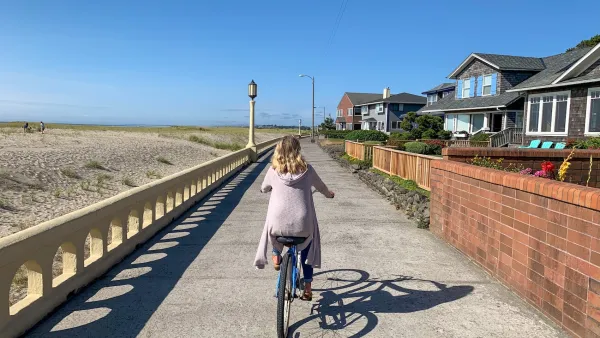
Oregon updates coastal bike map for the first time in a decade
The printed guide helps cyclists navigate the coastal region where cellular service can be unpredictable.
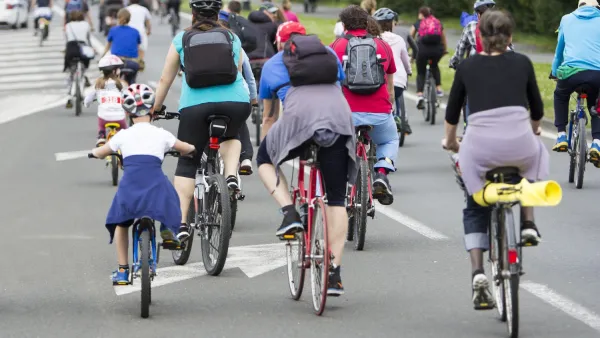
Unleashing the Power of Cycling With Smart Messaging
Lloyd Alter describes how creative design and copywriting can flip the script and promote active transport.

Planetizen Federal Action Tracker
A weekly monitor of how Trump’s orders and actions are impacting planners and planning in America.

Eastern Nebraska is running out of electricity
Data centers and electrification are straining eastern Nebraska’s grid, throttling economic development.

Study reveals best places in the U.S. for cycling, walking
New research from Streetlight Data examines bicycle and pedestrian miles per capita in the 100 largest U.S. cities by population.

DSA members accuse Mamdani of 'abandoning values' over housing redevelopment
New York City's mayor plans to replace about 2,000 units of public housing with private, mixed-income housing.

All sides of BRT debate unhappy with CDOT’s most recent move
The Colorado Department of Transportation is no longer considering center-running bus lanes for Colorado Boulevard.

Massachusetts bogs generate both power, and cranberries
Putting solar panels above farmland is one way Massachusetts is advancing toward its goal of net-zero carbon emissions by 2050.

FREE Course: Walkable City 1: Why Walkability?
After describing his path towards focusing on walkability as the essence of good planning, Jeff Speck marches through his five principal reasons for making more walkable places.
Reinventing Malls: Planning Alchemy—Turning Gray Fields Into Gold
The course focuses on the opportunities and imperatives that shape reinvention of mall sites.


City of Rosemead
Rutgers University, Edward J. Bloustein School of Planning and Public Policy
One Hundred Miles
University of Michigan School for Environment and Sustainability (SEAS)
Hunter College, City University of New York (CUNY)
The Architects Foundation
City of Cambridge
The Pocatello Development Authority
The Urban Renewal Agency of the City of Pocatello