Ever get frustrated looking for the right aerial image of your project site on Google Earth? Emily Badger has found the solution - a DIY balloon mapping kit developed by cartographer Stewart Long.


As Badger reports, the $95 DIY balloon mapping kit sold by the Public Laboratory for Open Technology and Science, has several advantages over the typical aerial image found on Google Maps or Google Earth. For one, you can capture images at higher resolution. "At this distance," says Badger, "you can get down to the centimeter, enough to capture the dotted lines on a road, or the tiles on a roof." You can also update images as necessary to document changing conditions.
"The whole idea is an ingenious mix of high and low tech, of rubber bands
and helium and open-source software (Public Labs also has a platform
called MapKnitter that will help
you stitch the images together into one big mosaic). But aside from its
basic techie appeal, this tool is trying to take map-making – for
centuries the province of people who are in charge – and give the rest
of us that power, too."
Read the full story: The Future of Aerial Mapmaking: Cheap Helium Balloons
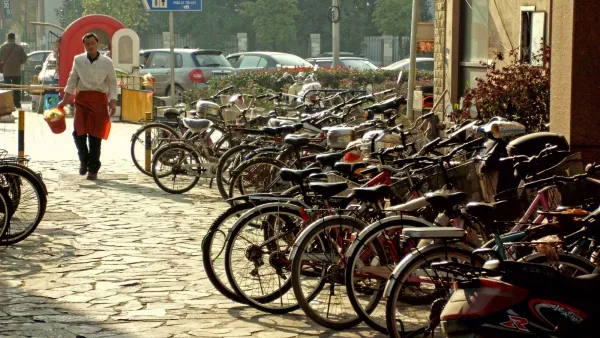
Friday Eye Candy: 195 Gigapixels of Urban Glory
An incredibly detailed bird's eye view of Shanghai.
New Research Methods Help Nebraska's Water Management Plan
Researchers at the University of Nebraska have been working with the Nebraska Department of Natural Resources to develop best practices for predicting and planning for the future water needs of urban developments.
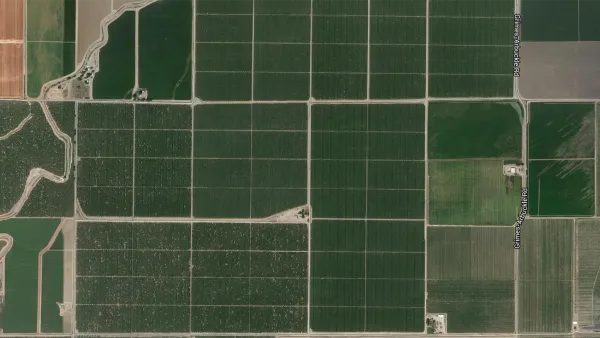
Friday Eye Candy: Where U.S. Roads Correct the Grid
Anyone who has traveled long country roads is familiar with the moment when a road makes a sharp turn to deviate from a direct path. Such "grid corrections" provide the subject for a photography project by Gerco de Ruijter.

Desperate measures: Advocates weigh draining Lake Powell to fill Colorado River
Draining the reservoir could reduce evaporation losses by a couple hundred thousand acre-feet.

Eastern Nebraska is running out of electricity
Data centers and electrification are straining eastern Nebraska’s grid, throttling economic development.

Malls are becoming the midtowns of the future
Mall and office park redevelopments are a generational opportunity to create new nodes of urbanity.

NYC breaks ground on anti-flooding infrastructure project
New York City's new system will reduce stormwater flows to local sewers by 90%.

One Kentucky town’s secret to affordable housing
The Smoketown Community Land Trust has already built seven affordable homes for community members.

Houston gains petal-shaped cooling infrastructure to make streets more ‘delightful’
The city has installed the pavilions along 15 blocks in Houston.

FREE Course: Walkable City 1: Why Walkability?
After describing his path towards focusing on walkability as the essence of good planning, Jeff Speck marches through his five principal reasons for making more walkable places.
Reinventing Malls: Planning Alchemy—Turning Gray Fields Into Gold
The course focuses on the opportunities and imperatives that shape reinvention of mall sites.

City of Rosemead
Rutgers University, Edward J. Bloustein School of Planning and Public Policy
One Hundred Miles
University of Michigan School for Environment and Sustainability (SEAS)
Hunter College, City University of New York (CUNY)
The Architects Foundation
City of Cambridge
Montrose County
The Pocatello Development Authority