This week it was announced that a private company will pick up the passenger rail ball dropped last year by Gov. Rick Scott by financing a $1 billion project to connect downtown Miami to Orlando by 2014.


When Governor Rick Scott turned down $2.4 billion in federal funds intended for a high-speed rail project last year, the prospects for improved passenger service for South Florida looked grim. Florida East Coast Industries (FECI) has stepped into the breach by announcing plans for All Aboard Florida, "a privately financed, $1 billion plan that will launch fast, hourly
passenger rail service between downtown Miami and Orlando by 2014," writes Andres Viglucci.
Although high-speed service is not part of FECI's plan, with intermediate stops in downtown Fort Lauderdale and West Palm Beach, the trains "will cover the 230 miles from Miami to Orlando in three hours and three minutes, significantly faster than it takes to drive," notes Viglucci.
Included in FECI's proposed project are plans to transform "the site of the original train station built by Henry Flagler that gave rise to the city of Miami." According to Viglucci, "FECI, the real estate arm of the conglomerate that also owns the Florida
East Coast freight-rail company, will build a new, landmark station and
a potentially massive mixed-use development on nine acres of fallow
land it owns just north of the Miami-Dade County Courthouse."
Read the full story: Passenger trains to run from Miami to Orlando
No Little Plans for Private Passenger Rail Service Between Miami and Orlando
The last private passenger rail in the United States closed in 1983, but a private company is working on a 240-mile service between Orlando and Florida. CityLab recently detailed how a relic of the past could transform the Florida of the future.
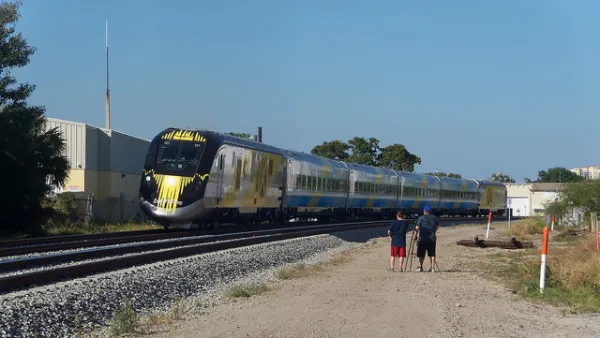
Florida's Brightline to Break Ground on Delayed Orlando Leg
The second phase of the highly anticipated Brightline express train service is finally moving forward after unanticipated delays.
Nation's Only Privately Funded Express Rail Service to Launch in July
Good and bad news for followers of Brightline, a South Florida rail start-up. Service between West Palm Beach and Fort Lauderdale begins in July, with Miami soon thereafter, but opponents may hamper extension to Orlando.

Planetizen Federal Action Tracker
A weekly monitor of how Trump’s orders and actions are impacting planners and planning in America.

California plans to bury El Niño’s downpour
If the state plays its cards right, it may be able to store a billion acre-feet of El Niño’s water in aquifers.

Desperate measures: Advocates weigh draining Lake Powell to fill Colorado River
Draining the reservoir could reduce evaporation losses by a couple hundred thousand acre-feet.

Seattle passes record-breaking transit services expansion
Proposition 1 will double the city’s transit tax to add 95,000 more bus trips and preserve 180,000 bus trips annually.

Post election, Texas is no longer Musk’s 'AI oasis'
Elon Musk dolled out $446 million on the 2026 midterms, the most ever spent by a non-canidate.

Chicago voters approve permanent festival grounds, penalty for vacant property owners
Currently, major summer and fall festivals take over public parks for weeks at a time, drawing criticism from nearby residents

FREE Course: Walkable City 1: Why Walkability?
After describing his path towards focusing on walkability as the essence of good planning, Jeff Speck marches through his five principal reasons for making more walkable places.
Reinventing Malls: Planning Alchemy—Turning Gray Fields Into Gold
The course focuses on the opportunities and imperatives that shape reinvention of mall sites.

City of Rosemead
Rutgers University, Edward J. Bloustein School of Planning and Public Policy
One Hundred Miles
Hunter College, City University of New York (CUNY)
The Architects Foundation
University of Cincinnati Online
City of Cambridge
Montrose County
The Pocatello Development Authority