Modern architecture's infatuation with glass, seen in sparkling residential and office towers rising in cities across North America, has been a bird killer of staggering proportions. Christopher Joyce profiles those trying to solve the problem.


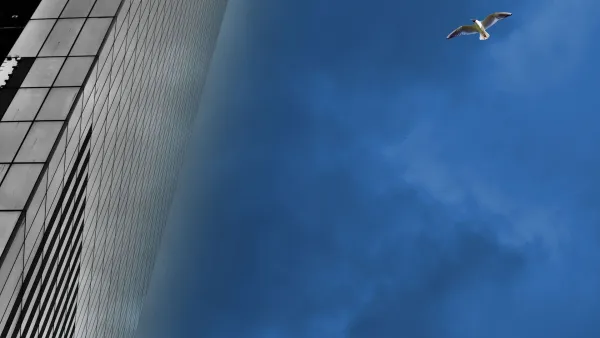
Because birds don't have depth perception like humans do, and can confuse the reflections in buildings with more sky, many are killed after colliding with glass windows and curtain walls - to the tune of 100 million to one billion (!) every year in North America by one estimate.
In recognition of the increasing problem, ornithologists and architects are working to devise solutions such as special glass coatings and frits to break up reflections and make buildings more visible to birds.
Additionally, "Several cities in the U.S. and Canada either have or are considering
new building codes that require bird-friendly materials. And there are
some quick fixes for windows - decals or sheets of patterned plastic
that attach to glass."
"But ideally," writes Joyce, "biologists
and architects want solutions that people can't see and that will be
standard products in buildings - and that won't cost an arm and a leg."
Thanks to Daniel Lippman
Read the full story: A Clear And Present Danger: How Glass Kills Birds

New York Largest U.S. City to Require Bird-Friendly Building Materials
The New York City Council approved Proposed Initiative 1482B by an overwhelming margin, ensuring bird-friendly design and construction practices in the largest U.S. city.
Toronto Towers Not Exactly Birds' Best Friends
A lethal combination of a rapidly expanding modern skyline and the intersection of several major migratory flight paths have rendered Toronto one of the world’s most deadly cities for migratory birds, reports Ian Austen.

Protecting Birds From Window Glass
Glass windows kill billions of birds each year. Simple fixes can help.

Planetizen Federal Action Tracker
A weekly monitor of how Trump’s orders and actions are impacting planners and planning in America.

Amtrak, CN end decades-long dispute with eight-year agreement
The new operating agreement establishes an updated framework for the companies to work together, including processes to resolve disputes.

Judges permit Denver to divert 77,000 acre feet from the Colorado River for reservoir expansion
Overuse and climate change have caused the Colorado River’s water levels to plummet.

NYC DOT wants faster, more permanent street upgrades
The city is examining ways to build more concrete infrastructure without getting entangled in 'decades-long' projects.

'Something we’ve never seen before:' rising utility rates could strain city finances nationwide
Data centers, climate change and other factors have caused utility rates in the United States to increase by 38% since 2020.

Trump to overrule local leaders, lease millions of acres of America’s Pacific Island territories’ seafloors to mining companies
International law says that the Indigenous people of America’s territories have a right to prior and informed consent regarding projects that impact their countries.

FREE Course: Walkable City 1: Why Walkability?
After describing his path towards focusing on walkability as the essence of good planning, Jeff Speck marches through his five principal reasons for making more walkable places.
Reinventing Malls: Planning Alchemy—Turning Gray Fields Into Gold
The course focuses on the opportunities and imperatives that shape reinvention of mall sites.

Harvard University Graduate School of Design
KFH Group Inc.
Greater Baltimore Committee
The Architects Foundation
University of Cincinnati Online
The Pocatello Development Authority
The Urban Renewal Agency of the City of Pocatello