As an increasing number of states seek to plug budget gaps and boost declining revenues by expanding gambling opportunities, the stakes keep getting higher in the competition to lure bettors.


Michael Cooper looks at the "feverish one-armed-bandit arms race" that has broken out throughout the East Coast, as neighboring states battle to poach and defend their gambling turf.
Take tiny Delaware for example, an early adopter, where "Gambling revenue accounts for more than 7 percent of Delaware's general
fund budget, making it the state's fourth biggest revenue stream, ahead
of its corporate income tax and gross receipts tax. But when new casinos
in Maryland and Pennsylvania began to attract the gamblers who once fed
quarters into Delaware's machines, the state acted. First it legalized a
form of sports betting. Then it allowed table games including
blackjack, craps and roulette. But its gambling revenues have continued
to fall."
In a desperate effort to feed their addiction to gambling revenue, Gov. Jack Markell signed a law at the end of June, "that
could make Delaware the first state to offer Internet gambling..."
"The endless one-upmanship among states has some analysts wondering at
what point the market will become saturated, and whether the industry
has reached a point of diminishing returns," writes Cooper.
Read the full story: States Up the Ante in Bid to Lure Other States’ Bettors

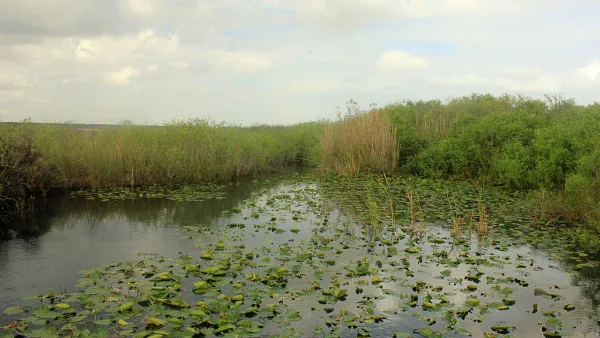
Water Quality Comes Up Trumps in New Florida Gambling Deal
Florida will direct almost all the revenue from its gambling compact with the Seminole Tribe to fund water quality projects, to the tune of billions.
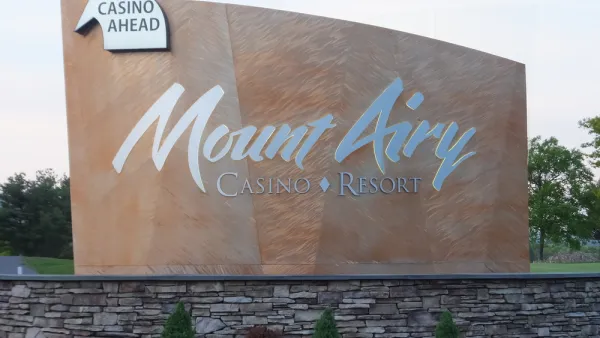
Pennsylvania's Gambling Expansion Proving Unpopular at the Local Level
The state thought more casinos would be a good way to raise some revenue for the state. So far a lot of local governments want no part of that action.
Pennsylvania House Goes All-In on Big Gambling Expansion
A bill that would greatly expand legalized gambling to new locations around the state flew through the Pennsylvania House of Representatives this week.

Planetizen Federal Action Tracker
A weekly monitor of how Trump’s orders and actions are impacting planners and planning in America.

California plans to bury El Niño’s downpour
If the state plays its cards right, it may be able to store a billion acre-feet of El Niño’s water in aquifers.

Chicago breaks ground on $3 billion megadevelopment
The new neighborhood, titled Foundry Park, will one day host 3,700 residences.

Want to study the Missouri River? Soon, you may need unanimous approval from 10 states
Legislation would require 10 governors’ permission to study or build projects moving water outside the basin.

Desperate measures: Advocates weigh draining Lake Powell to fill Colorado River
Draining the reservoir could reduce evaporation losses by a couple hundred thousand acre-feet.

This road in NYC is infamously dangerous — and Mamdani can't fix it
New York City's Ocean Parkway is known for reckless driving, but the power to implement safety measures lies with the state rather than the city.

FREE Course: Walkable City 1: Why Walkability?
After describing his path towards focusing on walkability as the essence of good planning, Jeff Speck marches through his five principal reasons for making more walkable places.
Reinventing Malls: Planning Alchemy—Turning Gray Fields Into Gold
The course focuses on the opportunities and imperatives that shape reinvention of mall sites.

City of Rosemead
Rutgers University, Edward J. Bloustein School of Planning and Public Policy
One Hundred Miles
Hunter College, City University of New York (CUNY)
The Architects Foundation
University of Cincinnati Online
City of Cambridge
Montrose County
The Pocatello Development Authority