Zipcar has released the results of their first Future Metropolis Index, which the company commissioned to recognize cities that demonstrate smart urban planning and policymaking, reports Ariel Schwartz.


Using data collected between July 2011–January 2012 KRC Research, the 36 largest cities in the country were ranked according to their achievements in providing innovative, sustainable, vibrant, efficient, and livable environments for their citizens. According to Schwartz, "These are arbitrary measures...But the measures do provide at least an outline of whether a city is future-forward or not.
In the overall rankings, "San Francisco comes out on top thanks to its many parks, arts-related businesses and jobs, high percentage of hybrid cars, and widespread use of public transportation."
Leaders in individual categories include Atlanta for innovation, Tucson for sustainability, San Francisco for vibrancy/creativity, Washington DC for efficiency, and El Paso for livability/optimism.
Read the full story: The Future Metropolis Index: U.S. Cities With The Best Urban Policies
Industry Wins a Round Over Building Efficiency Requirements
New regulations prohibit cities from enacting stricter efficiency standards in new buildings.
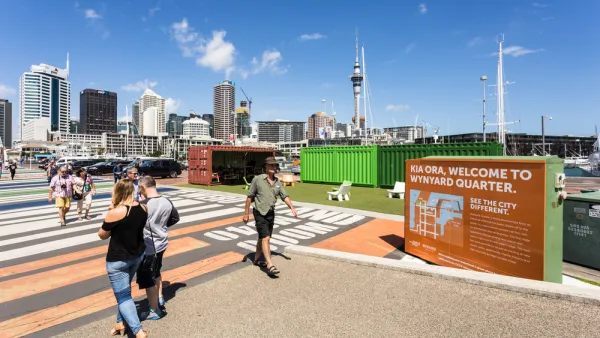
Considering Transportation Impacts on Well-Being and Livability
The New Zealand Transport Agency’s new report, "Transport Impacts on Wellbeing and Liveability" provides guidance for transportation planning that achieves fairness, neighborliness, respect, community identity, pride, fitness, and health.
California Energy Efficiency Program Could Be Much More Effective for Low-Income Residents
According to an analysis by the Energy Efficiency for All coalition, California's Energy Savings Assistance Program could be four times as effective for low-income renters if it were better deployed.

Desperate measures: Advocates weigh draining Lake Powell to fill Colorado River
Draining the reservoir could reduce evaporation losses by a couple hundred thousand acre-feet.

Eastern Nebraska is running out of electricity
Data centers and electrification are straining eastern Nebraska’s grid, throttling economic development.

Malls are becoming the midtowns of the future
Mall and office park redevelopments are a generational opportunity to create new nodes of urbanity.

NYC breaks ground on anti-flooding infrastructure project
New York City's new system will reduce stormwater flows to local sewers by 90%.

One Kentucky town’s secret to affordable housing
The Smoketown Community Land Trust has already built seven affordable homes for community members.

Houston gains petal-shaped cooling infrastructure to make streets more ‘delightful’
The city has installed the pavilions along 15 blocks in Houston.

FREE Course: Walkable City 1: Why Walkability?
After describing his path towards focusing on walkability as the essence of good planning, Jeff Speck marches through his five principal reasons for making more walkable places.
Reinventing Malls: Planning Alchemy—Turning Gray Fields Into Gold
The course focuses on the opportunities and imperatives that shape reinvention of mall sites.

City of Rosemead
Rutgers University, Edward J. Bloustein School of Planning and Public Policy
One Hundred Miles
University of Michigan School for Environment and Sustainability (SEAS)
Hunter College, City University of New York (CUNY)
The Architects Foundation
City of Cambridge
Montrose County
The Pocatello Development Authority