After moving swiftly through preliminary hearings in the Senate last week, that body's supposedly bipartisan transportation bill has been stopped in its tracks according to its sponsor Sen. Barbara Boxer, reports Keith Laing.


In today's highly charged congressional environment, made even more so by the looming presidential election, it should surprise no one to learn that the Senate's transportation bill, commonly referred to as MAP 21, has succumbed to the same partisan fighting that has stalled similar efforts in the House. As recently as last week, however, the prospects in the Senate looked much better.
So, with Boxer declaring yesterday that, "Right now, there is no path forward," what changed? According to Laing, "in a speech on the floor that Wednesday, Boxer said that the bill has been held up by 'ridiculously unrelated amendments.'" According to Boxer, "It's one of those things where people just say 'I don't care. We're not going to (approve) this bill."
Despite recent setbacks, Boxer declared emphatically, "that she would not allow the transportation bill to be permanently stopped during the amendment process," writes Laing.
FULL STORY: Boxer sees 'no path forward' on $109B Senate transportation bill

House Overwhelmingly Passes Republican Highway Trust Fund Patch Bill
By a vote of 367-55, the House passed Rep. Dave Camp's "pension smoothing" bill to provide ten months of funding for the deficit-plagued Highway Trust Fund through May. A long-term (five- or six-year) funding plan will be attempted then.
What's Wrong with the Senate's MAP-21 Reauthorization Bill?
Plenty, according to Tanya Snyder, Streetsblog USA editor, who finds Obama's Grow America plan far superior. Outside of not including a gas tax to fill the Trust Fund gap, she finds the proposal "underfunded and highway centric." She is not alone.
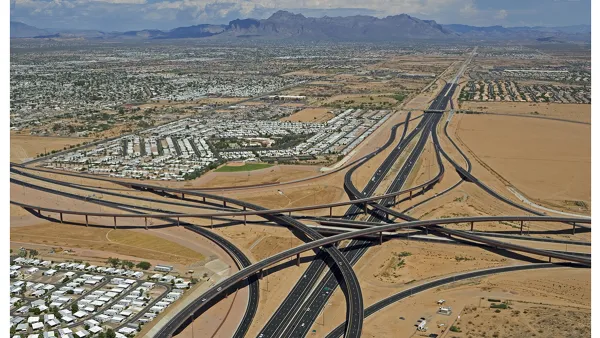
Senate Committee Releases Six-Year Transportation Reauthorization Bill
The bill to reauthorize the current surface transportation law, "Moving Ahead for Progress in the 21st Century", a.k.a. MAP-21, was released on Monday and will be "marked up" on Thursday. Spending is kept at current levels of $50 billion a year.

Planetizen Federal Action Tracker
A weekly monitor of how Trump’s orders and actions are impacting planners and planning in America.

The state-sanctioned urbicide of Austin
People don’t kill cities. Freeways do.

US to reduce Colorado River water deliveries to Mexico
A new Colorado Treaty amendment reduces Mexico’s Colorado River water allocation by 250,000 acre feet.

Guerilla urbanists are building DIY bus stop benches in Chicago
A before-and-after of one of the bus stops with a new bench. The new benches are not officially sanctioned or permitted, but the residents who placed them hope they will be the start of a network of DIY benches across the city.

Mamdani overhauls NYC's Vision Zero plan with 100 new policy goals
The overhaul aims to reduce traffic deaths and make streets safer for pedestrians, cyclists and drivers through lower speed limits, new safety infrastructure and more.

Amtrak not solely to blame for New Jersey commuter rail's unreliability, report finds
A new study from the Garden State Initiative found that NJ Transit’s budget grew 20% across a 4 year period, but reliability declined significantly over the same period.

FREE Course: Walkable City 1: Why Walkability?
After describing his path towards focusing on walkability as the essence of good planning, Jeff Speck marches through his five principal reasons for making more walkable places.
Reinventing Malls: Planning Alchemy—Turning Gray Fields Into Gold
The course focuses on the opportunities and imperatives that shape reinvention of mall sites.

Eagle County Government
Harvard University Graduate School of Design
Nashville Planning Department
The Architects Foundation
University of Cincinnati Online
The Pocatello Development Authority
The Urban Renewal Agency of the City of Pocatello
Journal of the American Planning Association