Kate Linthicum and Jessica Garrison recount the debate over a new proposal to overhaul Los Angeles's trash collection industry, as labor and environmental groups go head-to-head with waste haulers and business interests.


Currently, over 140 companies operate the big business of waste hauling in Los Angeles. A new recommendation from a labor-allied group would reduce that number to a handful of top-bid companies assigned to 11 new franchise zones dispersed throughout the city.
According to Linthicum and Garrison, "union and environmental groups say the new system would increase recycling and ease traffic and pollution caused when hordes of heavy trucks from competing companies crisscross neighborhoods to serve scattered customers."
"But business groups and many waste haulers warn that the proposal could cost renters and businesses a bundle and say it's chiefly a union gambit to use government policy to expand membership."
City support for the restructuring is being driven, at least in part, by L.A.'s goal of diverting 90% of waste away from landfills by 2025, which will require more coordination and accountability from trash companies.
The clash over trash contracting commenced Monday at Los Angeles City Hall.
Read the full story: L.A.'s trash industry gets ready to rumble
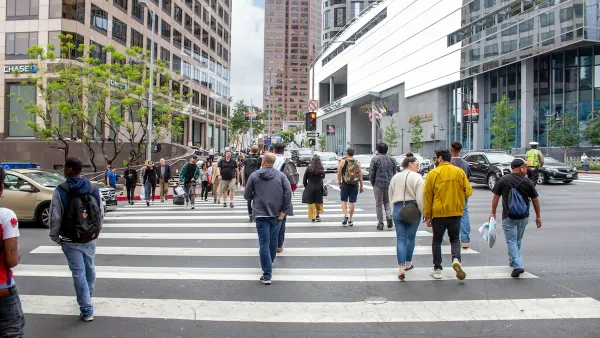
LA residents may be allowed to paint their own crosswalks
Councilwoman Katy Yaroslavsky put out a motion instructing the Los Angeles Department of Public Transportation to study the feasibility of allowing volunteers to paint crosswalks.
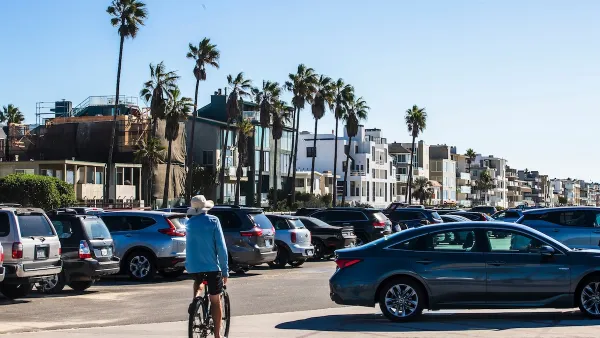
Not in my parking spot: LA renters oppose ADU development in their garages
Some tenants advocates say taking away residents’ parking spaces harms senior citizens and people with disabilities who rely on their cars to navigate the city.

LA may place emergency ban on karaoke room permits
If Councilwoman Heather Hutt’s proposal passes, the moratorium would last between 45 days and one year.

Planetizen Federal Action Tracker
A weekly monitor of how Trump’s orders and actions are impacting planners and planning in America.

California plans to bury El Niño’s downpour
If the state plays its cards right, it may be able to store a billion acre-feet of El Niño’s water in aquifers.

Desperate measures: Advocates weigh draining Lake Powell to fill Colorado River
Draining the reservoir could reduce evaporation losses by a couple hundred thousand acre-feet.

Mamdani’s pied-à-terre tax survives legal challenge
A panel of judges found that the plaintiffs failed to demonstrate injury as a result of New York City's implementation of the tax.

Eastern Nebraska is running out of electricity
Data centers and electrification are straining eastern Nebraska’s grid, throttling economic development.

Seattle passes record-breaking transit services expansion
Proposition 1 will double the city’s transit tax to add 95,000 more bus trips and preserve 180,000 bus trips annually.

FREE Course: Walkable City 1: Why Walkability?
After describing his path towards focusing on walkability as the essence of good planning, Jeff Speck marches through his five principal reasons for making more walkable places.
Reinventing Malls: Planning Alchemy—Turning Gray Fields Into Gold
The course focuses on the opportunities and imperatives that shape reinvention of mall sites.

City of Rosemead
Rutgers University, Edward J. Bloustein School of Planning and Public Policy
One Hundred Miles
University of Michigan School for Environment and Sustainability (SEAS)
Hunter College, City University of New York (CUNY)
The Architects Foundation
City of Cambridge
Montrose County
The Pocatello Development Authority