When a recent audit of the Port Authority's spending at ground zero turned up $3.8 billion in cost overruns, the Governors of New York and New Jersey went on the offensive. Michael Powell provides some cover for the agency.


While New York and New Jersey's top politicians were quick to criticize the spending of the Port Authority and its former head, Christopher Ward, Powell defends the cost overruns as the inevitable result of political decisions.
Seemingly overlooked in the audit was the unrealistic schedule and cost estimates that Ward identified when taking over the Authority in 2008. Furthermore, "The authority chairman, David Samson, a Christie appointee, also declined to plant a tomahawk in Mr. Ward's forehead. 'The costs were inevitable,' he said, 'once the decision was made in 2008 that we'd be open for the 10th anniversary.'"
According to Powell, "Amid the political bellowing, only one fellow remained steadfast in support of Mr. Ward: Mayor Michael R. Bloomberg. He had watched as Mr. Ward transformed ground zero into an elegant memorial site that draws millions of tourists."
Read the full story: Two Governors’ Sucker Punches at the Port Authority

Mosque Near Ground Zero Supported by Mayor Bloomberg
With the controversial mosque near Ground Zero clearing its last major legal hurdle, Mayor Bloomberg explains why the proposal should never have been opposed.
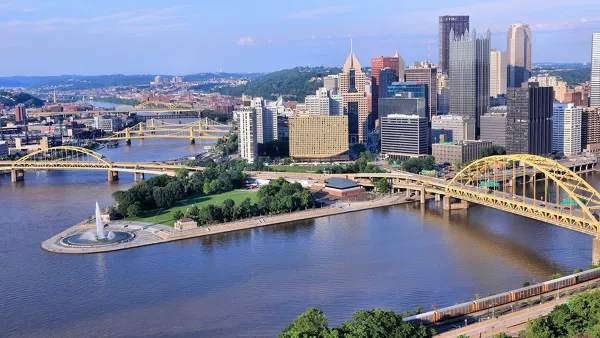
Port Authority Study Calls For More Equitable TOD in Pittsburgh
A study by the Port Authority of Allegheny County warns against displacement of low-income residents and calls for an increased focus on equity in developments around transit stations.
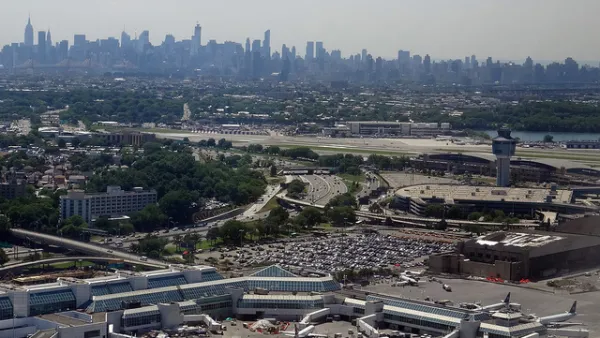
LaGuardia AirTrain, Pet Project of Ousted Governor, Paused by Successor
New York Governor Kathy Hochul has instructed the Port Authority of New York and New Jersey to rethink the plan for the $2.1 billion LaGuardia AirTrain, a contentious plan championed by former Governor Andrew Cuomo.

Planetizen Federal Action Tracker
A weekly monitor of how Trump’s orders and actions are impacting planners and planning in America.

The state-sanctioned urbicide of Austin
People don’t kill cities. Freeways do.

Colorado’s Largest Data Center Could Rise Next to Homes — Without a Public Hearing
The proposed campus would consume 11 times the power of Denver International Airport; as it has across the country, opposition mounts.

Nation's most wind-powered state turns to coal as data centers increase energy demand
For the first time in decades, Iowa has increased its generation of coal power.

NYC cools commuters with city's first rain garden above a bus stop
New York City officials say the plants in the rain garden can absorb 16 gallons of rainwater during heavy storms.

Brightline West’s future may rely on $6 billion federal loan
The company has until Nov. 2 to make a $400 million equity investment into its proposed high-speed rail line.

FREE Course: Walkable City 1: Why Walkability?
After describing his path towards focusing on walkability as the essence of good planning, Jeff Speck marches through his five principal reasons for making more walkable places.
Reinventing Malls: Planning Alchemy—Turning Gray Fields Into Gold
The course focuses on the opportunities and imperatives that shape reinvention of mall sites.

Greater Baltimore Committee
Eagle County Government
Harvard University Graduate School of Design
The Architects Foundation
University of Cincinnati Online
The Pocatello Development Authority
The Urban Renewal Agency of the City of Pocatello
Journal of the American Planning Association