James Kanter reports on plans by Danish government to generate half the nation’s power from wind within eight years, and whether too much of a good thing, in this case, may lead to failure.


Kanter looks at the country's existing wind power generation (currently less than 25% of the country's electricity sources) and recent capacity related issues, and sees a potential recipe for disaster.
The technology and infrastructure does not currently exist in Denmark to support such a shift and "a major concern is that the supply of electricity might exceed demand for about 1,000 hours each year by 2020 unless there are substantial changes in the way electricity is managed in Denmark, Mr. [Jens Moller] Birkebaek, [a vice president at Energinet.dk] said."
Where Anders Eldrup, the chief executive of the biggest Danish power utility, sees the opportunity to wean the country off coal plants within 20 years, Kanter sees, "the risks of expanding the reliance on renewable sources like wind before necessary grids, storage and other technologies are established to handle their intermittency and volatility."
Read the full story: Obstacles to Danish Wind Power

Can Maine Follow Denmark to Energy Independence?
Visitors from small islands off the coast of Maine traveled to Samsø, a larger island off the coast of Denmark, to learn how to emulate its transformation into a model of renewable energy.
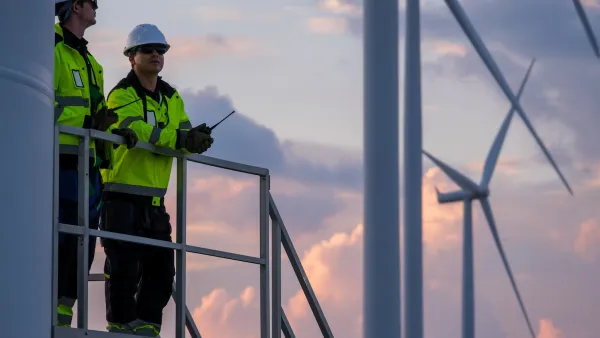
Despite court ruling, Trump is keeping nearly all wind projects in the US on hold
At least 110 wind energy projects have not heard from the government since a federal judge ruled that the Trump administration's freeze on wind turbine clearances was likely illegal.

Danish Suburb Introduces Red Streetlights to Protect Nocturnal Species
The town of Gladsaxe is using red-spectrum LEDs to illuminate streets where bat species congregate.

Planetizen Federal Action Tracker
A weekly monitor of how Trump’s orders and actions are impacting planners and planning in America.

Amtrak, CN end decades-long dispute with eight-year agreement
The new operating agreement establishes an updated framework for the companies to work together, including processes to resolve disputes.

Judges permit Denver to divert 77,000 acre feet from the Colorado River for reservoir expansion
Overuse and climate change have caused the Colorado River’s water levels to plummet.

NYC DOT wants faster, more permanent street upgrades
The city is examining ways to build more concrete infrastructure without getting entangled in 'decades-long' projects.

'Something we’ve never seen before:' rising utility rates could strain city finances nationwide
Data centers, climate change and other factors have caused utility rates in the United States to increase by 38% since 2020.

Trump to overrule local leaders, lease millions of acres of America’s Pacific Island territories’ seafloors to mining companies
International law says that the Indigenous people of America’s territories have a right to prior and informed consent regarding projects that impact their countries.

FREE Course: Walkable City 1: Why Walkability?
After describing his path towards focusing on walkability as the essence of good planning, Jeff Speck marches through his five principal reasons for making more walkable places.
Reinventing Malls: Planning Alchemy—Turning Gray Fields Into Gold
The course focuses on the opportunities and imperatives that shape reinvention of mall sites.

Harvard University Graduate School of Design
KFH Group Inc.
Greater Baltimore Committee
The Architects Foundation
University of Cincinnati Online
The Pocatello Development Authority
The Urban Renewal Agency of the City of Pocatello