Writing on the topic of Los Angeles Times Architecture Critic Christopher Hawthorne's year-long series exploring the city through its literature, Nate Berg talks to the author about his critical touchstones and common themes.


Hawthorne's undertaking, in which the author read and appraised 27 of the "most significant books on Southern California architecture and urbanism" over the past year, was driven by "a desire to highlight interesting works on the city, but also to push himself out of his comfort zone in terms of his knowledge and understanding of the city."
Hawthorne places three key works at the top of his canon: Carey McWilliams' 1946 Southern California: An Island on the Land, Reyner Banham's 1971 Los Angeles: The Architecture of Four Ecologies, and Mike Davis' 1990 City of Quartz.
At this key period in the region's history, "What the books have suggested to me," Hawthorne argues, "is that we really don't have – and need – a new framework for understanding the city at this moment in its history as it undergoes this transition."
Read the full story: The Struggle to Define L.A.'s Transitional Moment

Los Angeles: A Tale of Two Ecologies
The late architecture critic Reyner Banham and social historian Mike Davis had opposing viewpoints regarding Los Angeles' ecology, but in many ways their disparate takes complemented each other, writes urban planner Jonathan P. Bell.
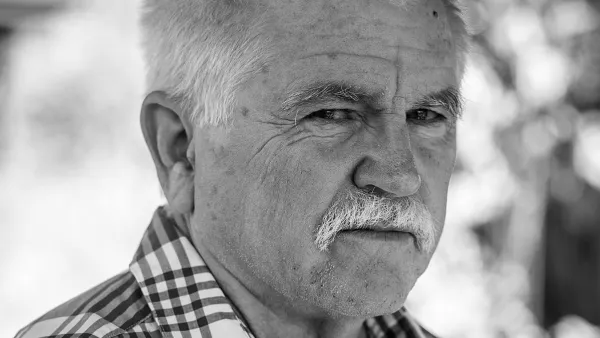
Remembering a Titan: Mike Davis Dies at 76
Davis’ unflinching portrait of Los Angeles politics and power dynamics remains a penetrating analysis of modern city-building, who it benefits, and who it leaves behind.
Mike Davis on Life, Politics, and Mortality
The celebrated City of Quartz author speaks with the Los Angeles Times about activism, climate change, and his decision to stop cancer treatment.

Planetizen Federal Action Tracker
A weekly monitor of how Trump’s orders and actions are impacting planners and planning in America.

‘Going backwards:’ Baltimore mayor, students rally against state's transit funding plan
Maryland's proposed six-year plan provides no funding for Baltimore’s BMORE bus program and reduces its road maintenance funding.

Detroit to transform waterfront with $2.2 billion investment
Developers will convert about 18 acres of unused parking lot space into civic spaces.

Guerilla urbanists’ DIY benches joined by sanctioned seats in Chicago
The group behind the original homemade benches said they will continue installing them across bench-less bus stops in Chicago.

Boston spent $765 million to lease battery-powered trains
The trains will serve Boston’s Fairmount Line for fifteen years.

NYC may expand key reservoir after devastating drought
The aqueduct that carries water from the reservoir to New York City has been leaking 35 million gallons of water per day since the 1990s.

FREE Course: Walkable City 1: Why Walkability?
After describing his path towards focusing on walkability as the essence of good planning, Jeff Speck marches through his five principal reasons for making more walkable places.
Reinventing Malls: Planning Alchemy—Turning Gray Fields Into Gold
The course focuses on the opportunities and imperatives that shape reinvention of mall sites.

One Hundred Miles
County of Mendocino
planning NEXT
The Architects Foundation
University of Cincinnati Online
Montrose County
Northern Illinois Transit Authority (NITA)
The Pocatello Development Authority