They're about to try it in Ulan Bator, Mongolia, creating giant "naleds" of ice that would melt slowly due to the extreme cold preserved inside.


The goal is to reduce the overall temperature of the city and to store much-need water in the dry region. The technique is similar to how ice rinks are created - just layered over and over again to create massive ice walls in strategic parts of the city.
The Guardian has the story:
"[Mongolian engineering firm ECOS & EMI] believe[s] their proposed use in Ulan Bator could set a positive example that allows northern cities around the world to save on summer air conditioning costs, regulate drinking supplies, and create cool microclimates."
Geoff Manaugh goes on to explore the use of frozen water as a construction material, which he says have often been used to build temporary bridges:
"The frames and techniques used for building with frozen water, then, are very similar to those used when dealing with concrete; in either case, it is the architecture of hardened liquids."
Read the full story: Project Ice Shield
Mongolia Constructs Glacier To Cool Capital
The Mongolian capital of Ulan Bator will begin construction this winter of an artificial glacier to cool the city next summer and provide melt water for drinking and irrigation.
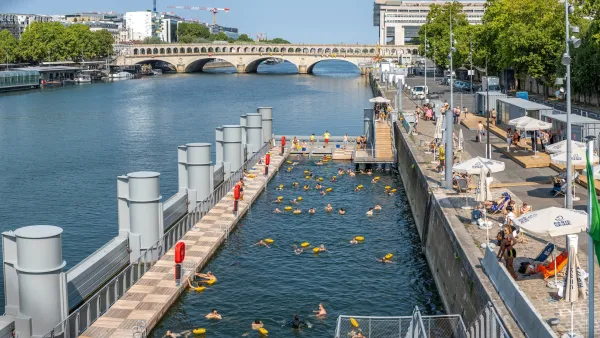
Paris is using Seine water to cool buildings
An underground network of pipes has been cooling public buildings since the 1990s.

The Pacific Northwest is an unlikely front in the fight for cooling
A 2021 heat dome killed over 250 people in the Pacific Northwest, bringing into sharp focus the potential of extreme heat to have deadly consequences even in historically cool climates.

Planetizen Federal Action Tracker
A weekly monitor of how Trump’s orders and actions are impacting planners and planning in America.

California plans to bury El Niño’s downpour
If the state plays its cards right, it may be able to store a billion acre-feet of El Niño’s water in aquifers.

Desperate measures: Advocates weigh draining Lake Powell to fill Colorado River
Draining the reservoir could reduce evaporation losses by a couple hundred thousand acre-feet.

Los Angeles just elected an urban planner as its mayor
Transportation analysts are optimistic that Raman will be more aggressive in addressing transit issues than Bass.

Mamdani’s pied-à-terre tax survives legal challenge
A panel of judges found that the plaintiffs failed to demonstrate injury as a result of New York City's implementation of the tax.

Eastern Nebraska is running out of electricity
Data centers and electrification are straining eastern Nebraska’s grid, throttling economic development.

FREE Course: Walkable City 1: Why Walkability?
After describing his path towards focusing on walkability as the essence of good planning, Jeff Speck marches through his five principal reasons for making more walkable places.
Reinventing Malls: Planning Alchemy—Turning Gray Fields Into Gold
The course focuses on the opportunities and imperatives that shape reinvention of mall sites.

City of Rosemead
Rutgers University, Edward J. Bloustein School of Planning and Public Policy
One Hundred Miles
University of Michigan School for Environment and Sustainability (SEAS)
Hunter College, City University of New York (CUNY)
The Architects Foundation
City of Cambridge
Montrose County
The Pocatello Development Authority