Executives of Rock Gaming LLC and its partner, Caesars Entertainment Corp, are hoping to revitalize Cleveland's downtown nightlife and create connections with nearby businesses by building Horseshoe Casino Cleveland.


Robert L. Smith of the Cleveland Plain dealer writes that the developers "...plan to partner with nearby restaurants and hotels for amenities their casino will purposely lack, sending people outside to dine, drink and explore."
Rock Gaming principal Dan Gilbert believes that the best way to create an exciting and optimistic downtown "...is to design a casino that enhances the attractions around it, creating a back-and-forth synergy that no suburb can match."
Klebanow, a former casino executive, believes this type of casino development a part of a "new era of urban casino development...We're starting to realize that building places that are integrated to the surrounding community is mutually beneficial."
"Horseshoe Casino Cleveland, when it opens next year, will be the only casino standing on the public square of a major American city."
Read the full story: Horseshoe Casino Cleveland aims to draw new crowd to downtown attractions
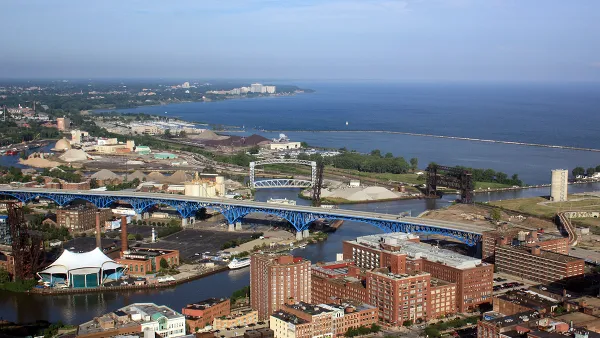
Developer in Cleveland Can Tax Patrons Directly
Lines between public and private blur as Flats East Bank takes on the mantle of a special tax district. If the measure goes through to completion, revenue will be used to fund public improvements.
How Cities Can Help Retail Catch Up with Residential
Scott Beyer details the old real estate wisdom of "retail follows rooftops," especially as evidenced by cities like Cleveland in recent years.
Cleveland Rocks
Downtown Cleveland has been polished up over the past few years. David C. Barnett has the rust belt revival success story.

Planetizen Federal Action Tracker
A weekly monitor of how Trump’s orders and actions are impacting planners and planning in America.

California plans to bury El Niño’s downpour
If the state plays its cards right, it may be able to store a billion acre-feet of El Niño’s water in aquifers.

Desperate measures: Advocates weigh draining Lake Powell to fill Colorado River
Draining the reservoir could reduce evaporation losses by a couple hundred thousand acre-feet.

Mamdani’s pied-à-terre tax survives legal challenge
A panel of judges found that the plaintiffs failed to demonstrate injury as a result of New York City's implementation of the tax.

Eastern Nebraska is running out of electricity
Data centers and electrification are straining eastern Nebraska’s grid, throttling economic development.

Seattle passes record-breaking transit services expansion
Proposition 1 will double the city’s transit tax to add 95,000 more bus trips and preserve 180,000 bus trips annually.

FREE Course: Walkable City 1: Why Walkability?
After describing his path towards focusing on walkability as the essence of good planning, Jeff Speck marches through his five principal reasons for making more walkable places.
Reinventing Malls: Planning Alchemy—Turning Gray Fields Into Gold
The course focuses on the opportunities and imperatives that shape reinvention of mall sites.

City of Rosemead
Rutgers University, Edward J. Bloustein School of Planning and Public Policy
One Hundred Miles
University of Michigan School for Environment and Sustainability (SEAS)
Hunter College, City University of New York (CUNY)
The Architects Foundation
City of Cambridge
Montrose County
The Pocatello Development Authority