Developers in Frederick, ND are aiming to build "green" homes that middle income buyers can afford. The homes are sporting features such as, solar panels, geothermal heating and high-tech computer systems that are typically found in high end homes.


Developers of the North Pointe neighborhood in Frederick are aiming to make it the first net-zero community in the region. The homes will be made with structurally insulated panels, use solar panels and geothermal systems.
The developer is "building energy-efficient townhouses and duplexes geared toward middle-class buyers. The 55 homes start in the mid-$200,000s..."
"North Pointe is part of a broader effort to revitalize the area. Frederick's housing authority, which owns the land on which the homes will be built, agreed to defer payment for the land as each sale is finalized, which helped defray costs and keep asking prices down, Murphy said. It didn't hurt that the land was previously developed - with roads, sidewalks and lights in place - so that construction of the homes could begin immediately."
"On top of all that, Nexus adjusted its profit margins to make the numbers work and leaned on its subcontractors to do the same, Murphy said. Economies of scale worked in the company's favor. Building communities, as opposed to just one home, helps tighten up the numbers, he said. Nexus plans to build hundreds of net zero homes in the Mid-Atlantic region."
Thanks to Cathie Pagano
FULL STORY: In Frederick, aiming to build ‘green homes’ that don’t break the bank

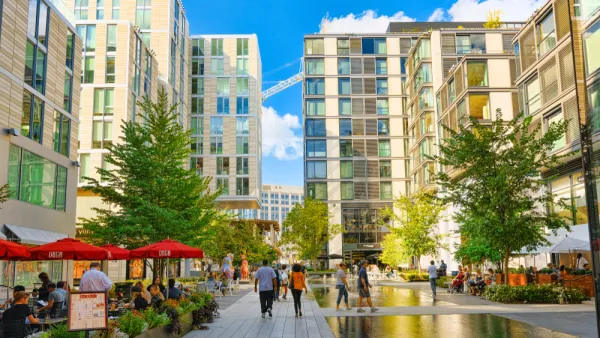
LEED Spells Rent Premiums in D.C.
In the multi-family residential market of Washington, D.C., LEED-certified buildings ask higher rents of residents.

The World's First LEED Platinum City: Washington, D.C.
In 2011, Washington, D.C. adopted the Sustainable D.C. plan, establishing the capital as a leader in green building and sustainability planning. In 2017, the city is the first in the world to achieve a new mark of distinction for its accomplishments.
Leinberger Op-Ed Supports Streetcars as Economic Development Tool
"Opposing streetcars and light rail today would be like opposing the building of freeways, the Beltway and Metrorail in the 20th century," writes Chris Leinberger in an op-ed for the Washington Post.

Planetizen Federal Action Tracker
A weekly monitor of how Trump’s orders and actions are impacting planners and planning in America.

The state-sanctioned urbicide of Austin
People don’t kill cities. Freeways do.

US to reduce Colorado River water deliveries to Mexico
A new Colorado Treaty amendment reduces Mexico’s Colorado River water allocation by 250,000 acre feet.

5 New England states march closer to 800 megawatt wind energy project
Securing federal approval for the project may be complicated under the Trump administration, which has historically been hostile towards domestic wind power.

Baltimore to break ground on $50 million Transit Priority Project
The project will bring faster bus trips, safer streets and better bike connections to Baltimore.

Airbnb launches $250 million 'last-dollar financing' housing accelerator, makes first investment in Austin
The company will put $6.4 million towards affordable housing development in Texas’ capital.

FREE Course: Walkable City 1: Why Walkability?
After describing his path towards focusing on walkability as the essence of good planning, Jeff Speck marches through his five principal reasons for making more walkable places.
Reinventing Malls: Planning Alchemy—Turning Gray Fields Into Gold
The course focuses on the opportunities and imperatives that shape reinvention of mall sites.

Eagle County Government
Harvard University Graduate School of Design
Nashville Planning Department
The Architects Foundation
University of Cincinnati Online
The Pocatello Development Authority
The Urban Renewal Agency of the City of Pocatello
Journal of the American Planning Association