With a growing demand for wireless internet, mobile communication networks may encroach on public space, writes Michael Chen, adjunct assistant professor at the Pratt Institute School of Architecture.


Designer and researcher Justin Snider and Chen, a principal of Normal Projects, started Signal Space, a project that analyzes the affect of broadcast and antenna infrastructure. Chen writes that the prominence and continued demand for mobile internet infrastructure creates a new layer of space, which Chen accordingly calls Signal Space.
"Our research into mobile infrastructure centers around identifying some of the developments in mobile technology that have the greatest potential to affect the future development of the city, and speculating on where they may have particular relevance for design.
"Rapidly increasing demand will mean that base stations, which today are almost exclusively located semi-stealthily on mid-rise building rooftops, will not only become denser, but will likely migrate into interiors, streets and other public spaces."
Read the full story: Signal Space

New Fiberoptic Cable Infrastructure Is Changing Alaska’s Classrooms
Rural Alaska has some of the least reliable and slowest internet connections in the country, but new cable infrastructure in the Arctic Sea is changing that.
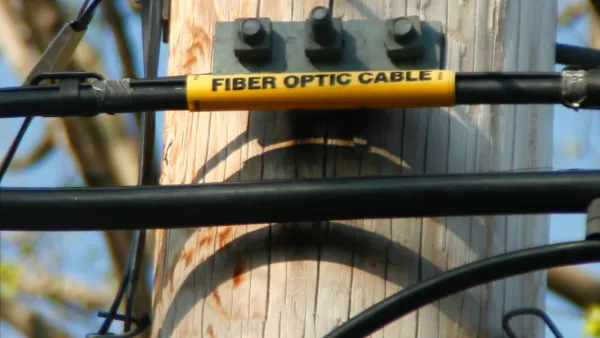
Digital Divide Broadens with Broadband
Accessing the internet is too expensive for many, not just in rural areas but also in cities.
Infrastructural Tourism Takes Off
Shannon Mattern examines how media scholars and environmental artists are working to reveal the material and immaterial infrastructures that shape our lives, from the Interstate to the Internet.

Desperate measures: Advocates weigh draining Lake Powell to fill Colorado River
Draining the reservoir could reduce evaporation losses by a couple hundred thousand acre-feet.

Eastern Nebraska is running out of electricity
Data centers and electrification are straining eastern Nebraska’s grid, throttling economic development.

Move over, LA: St. Louis gears up for Olympics, invests millions in downtown redevelopment
The Missouri city will host the 2028 Olympic soccer group stage and knockout matches.

Mass. votes against statewide minimum lot size for single-family homes
Over 2 million residents voted on Question 7; it was decided by just over 30,000 votes.

Maryland’s $15 billion bridge project gains key approval
The Maryland Transit Authority said the project will create over 60,000 jobs and add $23 billion to the local economy.

‘No clear next steps’ for Chicago's permanent festival grounds
Eleventh Ward Ald. Nicole Lee has suggested Soldier Field as a possible location for the permanent event space.

FREE Course: Walkable City 1: Why Walkability?
After describing his path towards focusing on walkability as the essence of good planning, Jeff Speck marches through his five principal reasons for making more walkable places.
Reinventing Malls: Planning Alchemy—Turning Gray Fields Into Gold
The course focuses on the opportunities and imperatives that shape reinvention of mall sites.

City of Rosemead
Rutgers University, Edward J. Bloustein School of Planning and Public Policy
One Hundred Miles
University of Michigan School for Environment and Sustainability (SEAS)
Hunter College, City University of New York (CUNY)
The Architects Foundation
City of Cambridge
Montrose County
The Pocatello Development Authority