Considering the Declaration of Independence and its mention of the "inalienable right" of "happiness", Kaid Benfield wonders what the pursuit of happiness can and should mean for communities.


The government of Bhutan has for decades kept track of its"gross national happiness", and others are starting to follow.
"Here in the US, an organization called Sustainable Seattle believes that happiness is an important policy objective whose achievement can be measured. The organization believes that Seattle, and by extension the U.S., should maintain a gross national happiness index to stand alongside economic measures such as gross domestic product. They, too, are conducting a survey.
The Seattle initiative's "objective indicators" of happiness include the poverty rate, air emissions, voter turnout, graduation rates, volunteer rates, rates of domestic violence and other crime, life expectancy, commute time, work time, and others. Nearly 2,500 residents of Seattle have taken the initiative's 135-question survey, says Eldan Goldenberg of Sustainable Seattle. Those who have apparently self-report favorably with respect to social connection, psychological well-being, and material well-being. but less well in their assessment of environmental quality and 'time balance.'"
Read the full story: 'The Pursuit of Happiness': How Do Communities Make Us Happy?
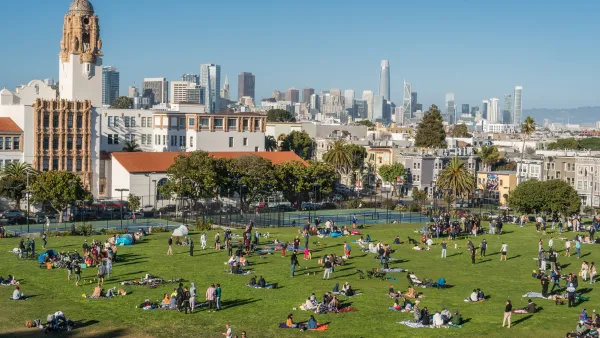
Only one US city makes the Happy City Index top 50
The list is topped by Copenhagen, Helsinki, and Geneva.

January Must-Reads: Top 10 Articles From Last Month
How a tidal wave of potential changes at the federal level could throw many programs planners depend on into chaos, a roundup of last year’s zoning stories, and the continuing ripple effects of a landmark Supreme Court case.
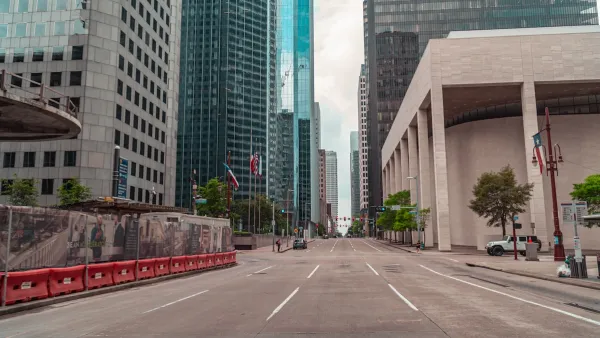
Research Links Urban Design and Human Happiness
An emerging field of ‘neuroarchitectural’ research is revealing how building facades and urban design impact the human brain and body.

Planetizen Federal Action Tracker
A weekly monitor of how Trump’s orders and actions are impacting planners and planning in America.

Eastern Nebraska is running out of electricity
Data centers and electrification are straining eastern Nebraska’s grid, throttling economic development.

Study reveals best places in the U.S. for cycling, walking
New research from Streetlight Data examines bicycle and pedestrian miles per capita in the 100 largest U.S. cities by population.

DSA members accuse Mamdani of 'abandoning values' over housing redevelopment
New York City's mayor plans to replace about 2,000 units of public housing with private, mixed-income housing.

All sides of BRT debate unhappy with CDOT’s most recent move
The Colorado Department of Transportation is no longer considering center-running bus lanes for Colorado Boulevard.

Massachusetts bogs generate both power, and cranberries
Putting solar panels above farmland is one way Massachusetts is advancing toward its goal of net-zero carbon emissions by 2050.

FREE Course: Walkable City 1: Why Walkability?
After describing his path towards focusing on walkability as the essence of good planning, Jeff Speck marches through his five principal reasons for making more walkable places.
Reinventing Malls: Planning Alchemy—Turning Gray Fields Into Gold
The course focuses on the opportunities and imperatives that shape reinvention of mall sites.

City of Rosemead
Rutgers University, Edward J. Bloustein School of Planning and Public Policy
One Hundred Miles
University of Michigan School for Environment and Sustainability (SEAS)
Hunter College, City University of New York (CUNY)
The Architects Foundation
City of Cambridge
The Pocatello Development Authority
The Urban Renewal Agency of the City of Pocatello