On the occasion of Jane Jacobs' birthday (and the international "Jane's Walks" held in her honor), Stephen Wickens muses on Jane Jacobs' legacy and the ways in which her ideas are used -- and misused -- in an age of superficial mass media.


Wickens considers the extent to which Jacobs' ideas are understood by contemporary planners and politicians. Part of the problem, he points out, is that
"she [will] never be widely understood, in part because news media...increasingly [opt] for simplistic explanations [and t]here are more intertwined concepts in The Death and Life than any newspaper story can outline.
But page 150...lists four conditions for any part of a city to generate 'exuberant diversity': that districts have a mix of primary uses; that most blocks be short; that buildings be of various ages; and that the area have sufficient density. It was indispensable that these areas accommodate various levels of income and commercial rents.
But simply to list the factors without the examples and complicated dynamics found in the book is almost to miss the point."
Read the full story: Jane Jacobs: Honoured in the breach
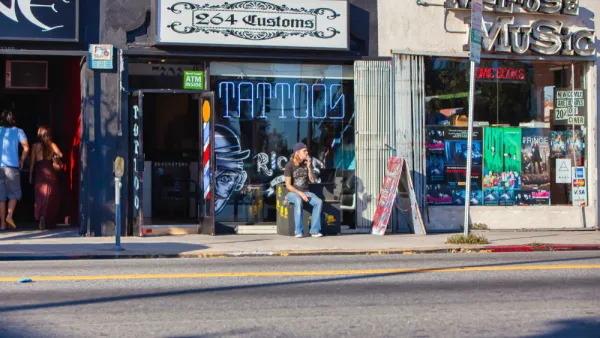
An Expanded Approach to the Analysis of Cities
Even with so much data in the world, cities are a slippery subject. What if an everyday part of life in cities—the "scenes" comprised by businesses, people, and practices of similarly distinct aesthetics—can help our understanding?
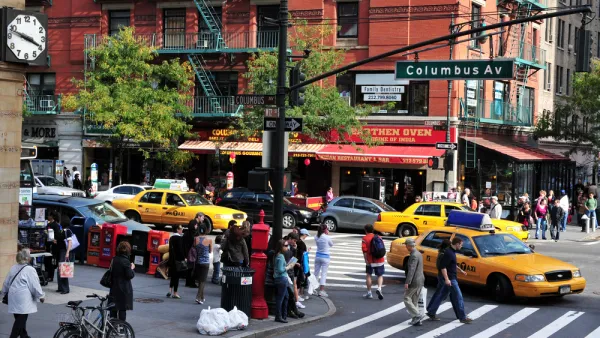
Looking Beyond the 'Sidewalk Ballet:' Jane Jacobs in the 21st Century
While The Death and Life of Great American Cities remains an urban planning classic, today's planners must contend with challenges that Jacobs couldn't have anticipated.
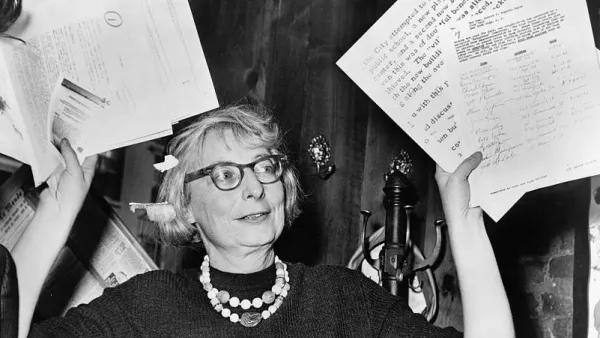
Deconstructing Saint Jane
The iconic urban thinker has influenced generations of planners, but how do her ideas hold up in an age of massive upheaval and economic inequality?

Planetizen Federal Action Tracker
A weekly monitor of how Trump’s orders and actions are impacting planners and planning in America.

California plans to bury El Niño’s downpour
If the state plays its cards right, it may be able to store a billion acre-feet of El Niño’s water in aquifers.

Desperate measures: Advocates weigh draining Lake Powell to fill Colorado River
Draining the reservoir could reduce evaporation losses by a couple hundred thousand acre-feet.

US buildings threatened, destroyed by fires set to triple by 2060
Researchers found a high fire risk for socioeconomically vulnerable neighborhoods in the American West.

LA residents may be allowed to paint their own crosswalks
Councilwoman Katy Yaroslavsky put out a motion instructing the Los Angeles Department of Public Transportation to study the feasibility of allowing volunteers to paint crosswalks.

Dallas moves to overhaul its zoning code
The city's zoning reform will allow more multi-family and mixed-use developments.

FREE Course: Walkable City 1: Why Walkability?
After describing his path towards focusing on walkability as the essence of good planning, Jeff Speck marches through his five principal reasons for making more walkable places.
Reinventing Malls: Planning Alchemy—Turning Gray Fields Into Gold
The course focuses on the opportunities and imperatives that shape reinvention of mall sites.

City of Rosemead
Rutgers University, Edward J. Bloustein School of Planning and Public Policy
One Hundred Miles
Hunter College, City University of New York (CUNY)
The Architects Foundation
University of Cincinnati Online
City of Cambridge
Montrose County
The Pocatello Development Authority