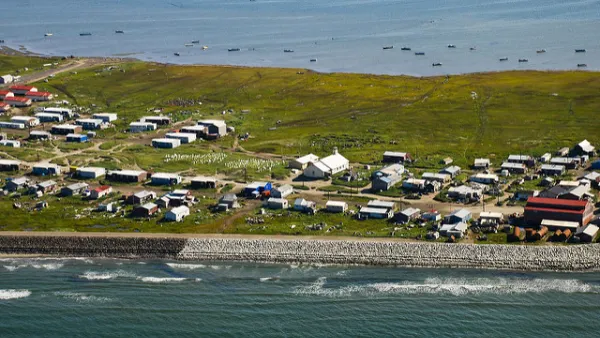
The village of Newtok, Alaska is subsiding into a nearby river as the permafrost beneath it melts. Villagers want to preserve their heritage, but face moving from their homeland.


This piece from Orion looks at the local culture of about 340 villagers who are having to transplant themselves to a new piece of land.
"Newtok lost nearly eighty feet of shoreline last year, and seventy the year before. 'It gets a little worse every year,' tribal administrator Stanley Tom tells me as we wing our way a few hundred feet above the ninety-four roadless miles of tundra between the city of Bethel and his village. As miles of bleak, white flatness scroll out beneath us, he describes every attempt that has been made to protect the village, most recently an elaborate network of boardwalks built above the permafrost. For most of the summer the boardwalks float and sway on spongy mud. Some have even sunk into the tundra, along with at least one corner of almost every house. Some of the village's structures, poised perilously at water's edge, have already been abandoned. Except for the recently constructed school, there are no level structures or surfaces left in Newtok."
Read the full story: Relocating Newtok
Coastal Tribes Facing Numerous Existential Threats From Climate Change
From Alaska to Washington, climate change is real, and it’s here now, for indigenous tribes.
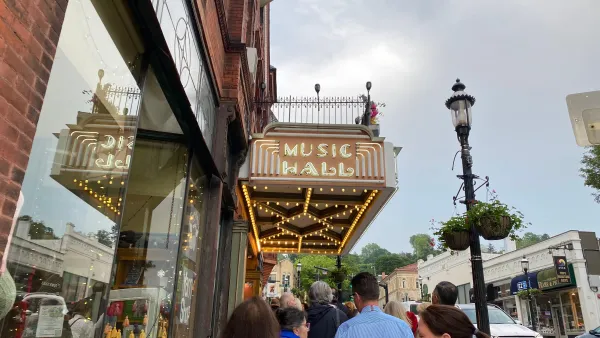
Why city hall doesn't know your music venue is a music venue (and why that matters)
Data shows that cultural venues have long lacked proper classification — which is why so many fall through the cracks.
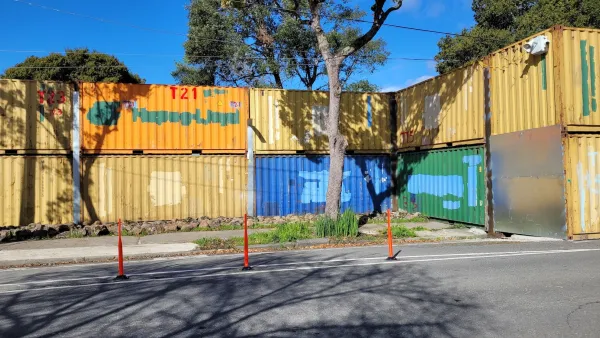
Berkeley promised to build supportive housing in People's Park. Where is it?
More than two years after People's Park was cordoned off, there is no word on a timeline for a promised affordable housing project.

Planetizen Federal Action Tracker
A weekly monitor of how Trump’s orders and actions are impacting planners and planning in America.

Eastern Nebraska is running out of electricity
Data centers and electrification are straining eastern Nebraska’s grid, throttling economic development.

Study reveals best places in the U.S. for cycling, walking
New research from Streetlight Data examines bicycle and pedestrian miles per capita in the 100 largest U.S. cities by population.

DSA members accuse Mamdani of 'abandoning values' over housing redevelopment
New York City's mayor plans to replace about 2,000 units of public housing with private, mixed-income housing.

All sides of BRT debate unhappy with CDOT’s most recent move
The Colorado Department of Transportation is no longer considering center-running bus lanes for Colorado Boulevard.

Massachusetts bogs generate both power, and cranberries
Putting solar panels above farmland is one way Massachusetts is advancing toward its goal of net-zero carbon emissions by 2050.

FREE Course: Walkable City 1: Why Walkability?
After describing his path towards focusing on walkability as the essence of good planning, Jeff Speck marches through his five principal reasons for making more walkable places.
Reinventing Malls: Planning Alchemy—Turning Gray Fields Into Gold
The course focuses on the opportunities and imperatives that shape reinvention of mall sites.

City of Rosemead
Rutgers University, Edward J. Bloustein School of Planning and Public Policy
One Hundred Miles
University of Michigan School for Environment and Sustainability (SEAS)
Hunter College, City University of New York (CUNY)
The Architects Foundation
City of Cambridge
The Pocatello Development Authority
The Urban Renewal Agency of the City of Pocatello