The federal government is attempting to pay closer attention to urban issues, and its Department of Housing and Urban Development is leading the way.


Next American City profiles HUD in transition, and talks with its secretary, Shaun Donovan, about what's going to be different.
"Obama's team took office in crisis mode, with housing the most pressing concern. They had to, at once, try to help keep Americans in their homes and promote an agenda of change and sustainability. Put another way, they had to help keep hard-hit sprawling suburbs, the least sustainable urban forms, above water, while promoting a nationwide agenda for sustainability. 'Chewing gum while walking' doesn't seem to do this justice, but those are the words HUD Secretary Shaun Donovan uses to describe their strategy.
Donovan believes the interagency partnership is the 'most potent' example of how the administration has used the housing crisis as an opportunity to lay a long-term foundation for sustainability and equity. 'For those who haven't worked in government,' he says, 'it may not seem like it's transformational, but the idea that my team is sitting in a room with [DOT head] Ray LaHood's team and [EPA director] Lisa Jackson's team evaluating TIGER [Transportation Investment Generating Economic Recovery] grant applications for streetcars and other critical infrastructure investments means that we're really transforming the sort of siloed approach that the federal government has traditionally taken.'"
Read the full story: URBAN NATION
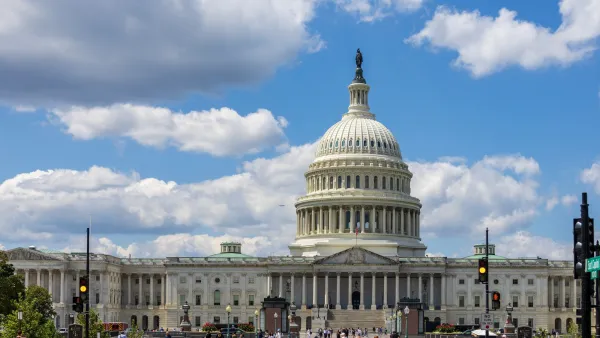
Analysis: ROAD to Housing Act could take years to implement
HUD is tasked with implementing nine new rules as part of the ROAD to Housing Act — while operating with a significantly reduced staff.
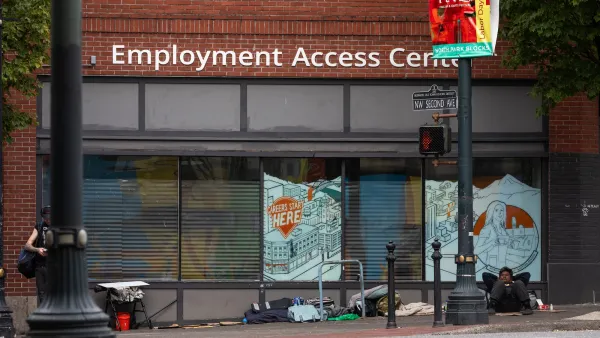
Judge: HUD acted illegally in changing homelessness grant rules
A Rhode Island judge struck down 'partisan' Trump restrictions on Continuum of Care Build grants.

Judge Blocks HUD Changes to Key Homelessness Grant Program
The Continuum of Care Program, the federal government’s biggest pool of funds for housing homeless people, will continue with its original funding plan — pending a final decision from the courts.

Planetizen Federal Action Tracker
A weekly monitor of how Trump’s orders and actions are impacting planners and planning in America.

California plans to bury El Niño’s downpour
If the state plays its cards right, it may be able to store a billion acre-feet of El Niño’s water in aquifers.

Desperate measures: Advocates weigh draining Lake Powell to fill Colorado River
Draining the reservoir could reduce evaporation losses by a couple hundred thousand acre-feet.

Los Angeles just elected an urban planner as its mayor
Transportation analysts are optimistic that Raman will be more aggressive in addressing transit issues than Bass.

Mamdani’s pied-à-terre tax survives legal challenge
A panel of judges found that the plaintiffs failed to demonstrate injury as a result of New York City's implementation of the tax.

Eastern Nebraska is running out of electricity
Data centers and electrification are straining eastern Nebraska’s grid, throttling economic development.

FREE Course: Walkable City 1: Why Walkability?
After describing his path towards focusing on walkability as the essence of good planning, Jeff Speck marches through his five principal reasons for making more walkable places.
Reinventing Malls: Planning Alchemy—Turning Gray Fields Into Gold
The course focuses on the opportunities and imperatives that shape reinvention of mall sites.

City of Rosemead
Rutgers University, Edward J. Bloustein School of Planning and Public Policy
One Hundred Miles
University of Michigan School for Environment and Sustainability (SEAS)
Hunter College, City University of New York (CUNY)
The Architects Foundation
City of Cambridge
Montrose County
The Pocatello Development Authority