Conflicts inevitably arise during design discussions and policy talks. A team of architects has created a new way of understanding each side's concerns, mainly by diagramming them into distinct domes.


Urban Omnibus interviews creators Janette Kim and Erik Carver about the Underdomes idea, which uses Buckminster Fuller's and Shoji Sadao's Dome Over Manhattan concept as a guiding metaphor.
"Janette Kim: Sometimes it seems that the role of the architect, when it comes to saving energy, is to source the right product or to calculate LEED points - as though the engineers and the bureaucrats alone can find the right way to minimize our energy usage. Or sometimes we push for design strategies - self-sustaining cities, locavore farms, town center densification - without interrogating some of the assumptions and belief systems behind them.
But when two contending approaches to energy are compared side-by-side, bigger issues emerge. Should we invest in market-based development of efficient products or support direct government investment in new infrastructures? Should we build zero-emissions cities in the desert, or revise the distribution networks of today? Should we buy better or consume less?"
Read the full story: Underdome
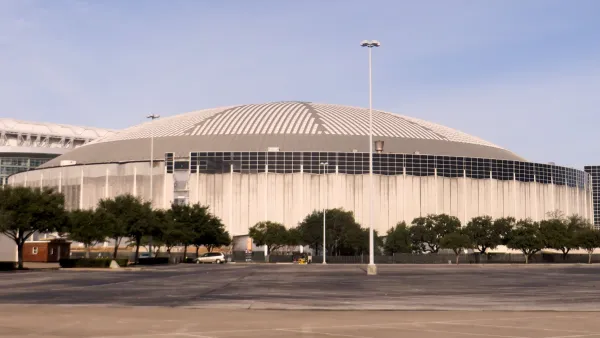
Renewed Efforts to Redevelop Houston's Historic Astrodome
A nonprofit hopes to create a viable plan for the iconic stadium—and find a way to pay for it.

Watch: The Future of Cities After COVID-19
An expert panel convened to discuss the effect of the coronavirus on the foundations of society and contemporary life. The future, both the remaining time dealing with the pandemic and after, is becoming more clear with every passing day and week.
Inside the Plans to Build a Domed City in Dubai
Plans are underway to build the world's first domed city.

Planetizen Federal Action Tracker
A weekly monitor of how Trump’s orders and actions are impacting planners and planning in America.

California plans to bury El Niño’s downpour
If the state plays its cards right, it may be able to store a billion acre-feet of El Niño’s water in aquifers.

Desperate measures: Advocates weigh draining Lake Powell to fill Colorado River
Draining the reservoir could reduce evaporation losses by a couple hundred thousand acre-feet.

Housing is the top priority of Seattle’s sole new councilmember
Jenks campaigned on building 1,000 new units of affordable housing.

New tax cuts may slash $1.5 billion in funding for Miami transit, public parks
Amendment 3 will save Miami-Dade homeowners $2,700 in 2028.

Arizona, Wisconsin, Pennsylvania hope to finally advance climate goals post-midterms
The three states have spent years under Republican or divided control.

FREE Course: Walkable City 1: Why Walkability?
After describing his path towards focusing on walkability as the essence of good planning, Jeff Speck marches through his five principal reasons for making more walkable places.
Reinventing Malls: Planning Alchemy—Turning Gray Fields Into Gold
The course focuses on the opportunities and imperatives that shape reinvention of mall sites.

City of Rosemead
Rutgers University, Edward J. Bloustein School of Planning and Public Policy
One Hundred Miles
University of Michigan School for Environment and Sustainability (SEAS)
Hunter College, City University of New York (CUNY)
The Architects Foundation
City of Cambridge
Montrose County
The Pocatello Development Authority