Nicolai Ouroussoff, The New York Times' architecture critic, argues that philistine planning decisions such as the one that restricted the height of Jean Nouvel's proposed tower last month, "risk transforming a living city into an urban mausoleum."


The building would have been as tall as the Empire State Building, minus its antenna, "a fact that probably made planners tremble." Amanda Burden, the city planning commissioner, said the tower's top, did not live up to the aesthetic standards of a building that would compete with the Manhattan's most famous towers.
Ouroussoff counters that "the desire of each new generation of architects and builders to leave its mark on the city, to contribute its own forms, is essential to making New York what it is." The soaring height and slender way in which Nouvel's tower achieves it captured the spirit of midtown Manhattan and 'brought that spirit forcefully into the present."
Read the full story: Off With Its Top! City Cuts Tower to Size

The Empire State Building's New Neighbor
A controversial new skyscraper seen as a challenge to the historical skyline dominance of the Empire State Building has been approved in New York City.
Potential Neighbor Threatens Empire State Building's Dominance
A proposed tower that would be just blocks from the Empire State Building in New York City has some historians and property owners on the defensive.
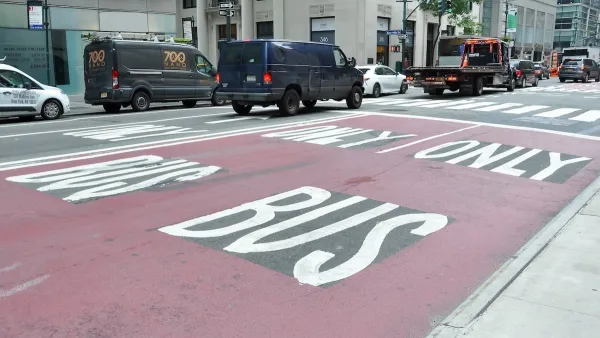
NYC DOT wants faster, more permanent street upgrades
The city is examining ways to build more concrete infrastructure without getting entangled in 'decades-long' projects.

Planetizen Federal Action Tracker
A weekly monitor of how Trump’s orders and actions are impacting planners and planning in America.

Amtrak, CN end decades-long dispute with eight-year agreement
The new operating agreement establishes an updated framework for the companies to work together, including processes to resolve disputes.

Judges permit Denver to divert 77,000 acre feet from the Colorado River for reservoir expansion
Overuse and climate change have caused the Colorado River’s water levels to plummet.

NYC DOT wants faster, more permanent street upgrades
The city is examining ways to build more concrete infrastructure without getting entangled in 'decades-long' projects.

'Something we’ve never seen before:' rising utility rates could strain city finances nationwide
Data centers, climate change and other factors have caused utility rates in the United States to increase by 38% since 2020.

Trump to overrule local leaders, lease millions of acres of America’s Pacific Island territories’ seafloors to mining companies
International law says that the Indigenous people of America’s territories have a right to prior and informed consent regarding projects that impact their countries.

FREE Course: Walkable City 1: Why Walkability?
After describing his path towards focusing on walkability as the essence of good planning, Jeff Speck marches through his five principal reasons for making more walkable places.
Reinventing Malls: Planning Alchemy—Turning Gray Fields Into Gold
The course focuses on the opportunities and imperatives that shape reinvention of mall sites.

Harvard University Graduate School of Design
KFH Group Inc.
Greater Baltimore Committee
The Architects Foundation
University of Cincinnati Online
The Pocatello Development Authority
The Urban Renewal Agency of the City of Pocatello