For a few weeks in 2012 a part of East London will be host to 20,000 journalists. After the Summer Olympics, though, the area set to host the media will be a mixed use neighborhood of nearly 3,000 homes, if all goes as planned.


"[I]t is around the international broadcast center and the main press center that the Olympic Park Legacy Company envisions the heart of a new commercial and residential zone in an area about 20 minutes by train from central London.
'What we're really trying to create is the sense of a place, the sense of a district,' the legacy chief executive Andrew Altman, an American urban planner, said during a recent tour of the area. 'It's almost a bit like a campus. You can imagine the kind of setting this would be for people who want to work here.'"
Officials working on planning the event are paying special attention to its legacy, and this new neighborhood is seen as one of the major efforts to leave a positive impact.
Read the full story: Re-Imagining an Area of London After the 2012 Olympics
Touring Olympic Redevelopment in London
Tourists can get a close-up look at the transformation of a formerly depressed part of East London into what will be the site of one of the world's largest spectacles when it hosts the 2012 Olympics.
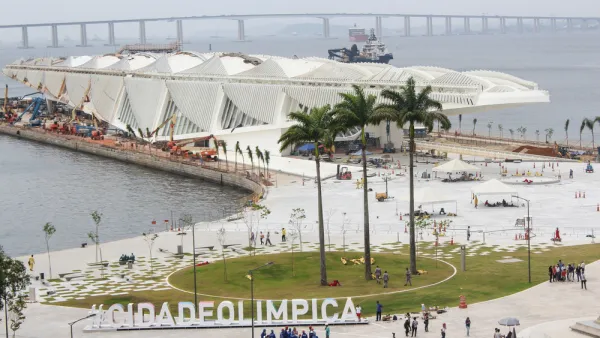
Abandoned Olympic Venues Cast Doubt on the Value of Hosting
Though cities hope for an economic boost, these photos show it's far from guaranteed.
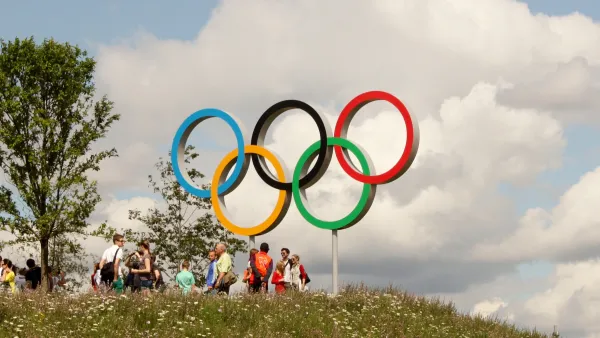
For Host Cities, Olympic Legacies Are Mixed
The two-week competition is often touted as a galvanizing force for urban development. But that's only cities include the Games' legacy in their planning process from the start.

Planetizen Federal Action Tracker
A weekly monitor of how Trump’s orders and actions are impacting planners and planning in America.

California plans to bury El Niño’s downpour
If the state plays its cards right, it may be able to store a billion acre-feet of El Niño’s water in aquifers.

Desperate measures: Advocates weigh draining Lake Powell to fill Colorado River
Draining the reservoir could reduce evaporation losses by a couple hundred thousand acre-feet.

US buildings threatened, destroyed by fires set to triple by 2060
Researchers found a high fire risk for socioeconomically vulnerable neighborhoods in the American West.

LA residents may be allowed to paint their own crosswalks
Councilwoman Katy Yaroslavsky put out a motion instructing the Los Angeles Department of Public Transportation to study the feasibility of allowing volunteers to paint crosswalks.

Dallas moves to overhaul its zoning code
The city's zoning reform will allow more multi-family and mixed-use developments.

FREE Course: Walkable City 1: Why Walkability?
After describing his path towards focusing on walkability as the essence of good planning, Jeff Speck marches through his five principal reasons for making more walkable places.
Reinventing Malls: Planning Alchemy—Turning Gray Fields Into Gold
The course focuses on the opportunities and imperatives that shape reinvention of mall sites.

City of Rosemead
Rutgers University, Edward J. Bloustein School of Planning and Public Policy
One Hundred Miles
Hunter College, City University of New York (CUNY)
The Architects Foundation
University of Cincinnati Online
City of Cambridge
Montrose County
The Pocatello Development Authority