Urban agriculture is not a new idea. Grist's Tom Philpott says the renewed interest in the idea should look for good ideas from its past.


By looking at the history of city farming, this piece argues that the recent growth of urban agriculture doesn't need to reinvent the wheel.
"Cities didn't just innovate techniques that would later become associated with large-scale, chemical-dependent agriculture, they also incubated sustainable ones. The so-called "French-intensive" method of growing vegetables -- in which large amounts of compost are added annually to densely planted raised beds -- is one of the most productive and sustainable forms of organic agriculture used today. And guess what? It developed not in the countryside, but rather within the crowded arrondissements of 19th century Paris. Maine farmer Eliot Coleman, one of the leading U.S. practitioners of the French-intensive style, credits those pioneering Parisian farmers with ingenious methods of extending growing seasons that are only just now coming into widespread use in the United States."
Read the full story: The history of urban agriculture should inspire its future

Fish: the Future of Urban Farming
Cityscape Farms has developed a new technique for farming fish along with vegetables in combined urban food systems that allows them to farm in developed areas.

Urban Farming Addressing Hunger (and More) in Pittsburgh
Urban farming provides opportunities to increase food security in addition to other benefits.
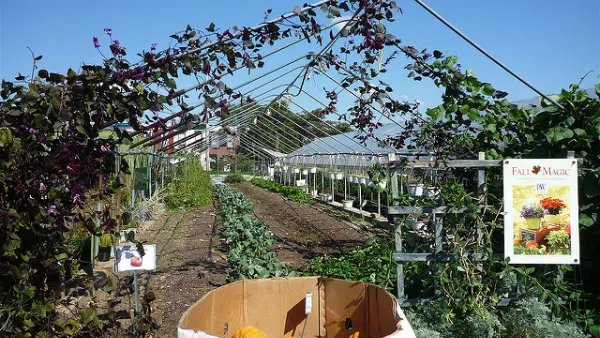
Minnesota Grants May Bolster Urban Farming's Legitimacy
For the first time, the state of Minnesota is offering money specifically for urban agriculture, in a win for urban farmers who want to challenge the notion that agriculture is necessarily a rural enterprise.

Planetizen Federal Action Tracker
A weekly monitor of how Trump’s orders and actions are impacting planners and planning in America.

Northwest rail fans eager for Sept. 30 debut of Amtrak’s Airo fleet
Get ready for that new train smell and more seats. But they won’t go faster or run more frequently on the Cascades route in Washington and Oregon.

Trump is considering data centers on 6 states' public land — some state officials say they had no idea
If the administration approves the proposed projects, data center and data center-related developments will cover 17,600 acres of public land.

After decades of planning, Sacramento gains new light rail station
Trains will arrive every 15 minutes during peak hours and every 30 minutes during non-peak hours.

Massive tunnel-boring machine breaks ground on Gateway Project
The Trump administration revoked funding for the project in October 2025, and then restored it earlier this year.

Airo trainsets begin service on Amtrak Cascades route
The trains feature panoramic windows, complementary wifi and over 300 seats per train set.

FREE Course: Walkable City 1: Why Walkability?
After describing his path towards focusing on walkability as the essence of good planning, Jeff Speck marches through his five principal reasons for making more walkable places.
Reinventing Malls: Planning Alchemy—Turning Gray Fields Into Gold
The course focuses on the opportunities and imperatives that shape reinvention of mall sites.

City of Thousand Oaks
City of Wisconsin Rapids
Harvard University Graduate School of Design
The Architects Foundation
University of Cincinnati Online
Northern Illinois Transit Authority (NITA)
The Pocatello Development Authority
The Urban Renewal Agency of the City of Pocatello