Katherine Don looks back at Broadacre City, Wright's attempt to replace the modern industrial city once and for all.


The design for Broadacre City was a rebuttal to Le Corbusier's Radiant City. Wright called for "a new standard of space measurement-the man seated in his automobile."
Don writes, "Even in the 1930s, urban planners were disgusted by Broadacre. Its philosophy was deeply individualistic; its layout was conspicuously wasteful. Liberals of the time who emulated the socialist spirit of Europe classified Wright as an anti-government eccentric, which indeed he was. In 1938, Marxist art historian Meyer Schapiro condemned Broadcre City as 'perfectly consistent with physical and spiritual decay.'"
Read the full story: Frank Lloyd Wright's Utopian Dystopia
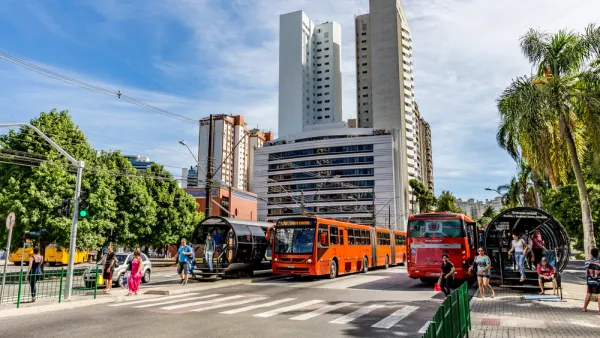
The Evolution of Green Urbanism
Today’s "Eco" or "Green" Urbanism movement has ancient, cross-cultural roots. This history is worth contemplating for lessons relevant to sustainable planning and design.
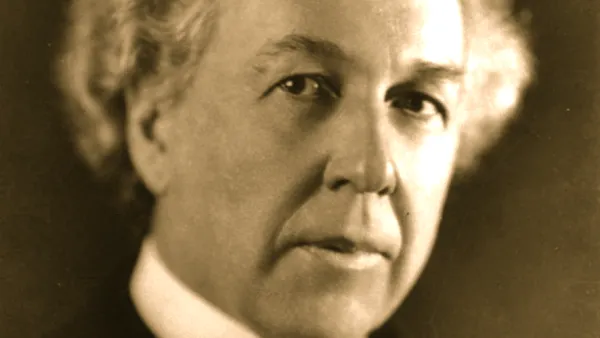
Choice Slights from Frank Lloyd Wright
In a 1957 book, author Selden Rodman collected conversations with 35 of America's preeminent artists and architects. The interviews with Frank Lloyd Wright are a font of choice quotes on topics from Le Corbusier to NYC's density.
The 10 Diagrams That Changed Planning
A new exhibit that opened this week at the San Francisco Planning and Urban Research Association's gallery explores the 10 diagrams that have had a monumental influence on urban planning, and the possibilities inherent in the medium.

Planetizen Federal Action Tracker
A weekly monitor of how Trump’s orders and actions are impacting planners and planning in America.

California plans to bury El Niño’s downpour
If the state plays its cards right, it may be able to store a billion acre-feet of El Niño’s water in aquifers.

Desperate measures: Advocates weigh draining Lake Powell to fill Colorado River
Draining the reservoir could reduce evaporation losses by a couple hundred thousand acre-feet.

Mamdani’s pied-à-terre tax survives legal challenge
A panel of judges found that the plaintiffs failed to demonstrate injury as a result of New York City's implementation of the tax.

Eastern Nebraska is running out of electricity
Data centers and electrification are straining eastern Nebraska’s grid, throttling economic development.

Seattle passes record-breaking transit services expansion
Proposition 1 will double the city’s transit tax to add 95,000 more bus trips and preserve 180,000 bus trips annually.

FREE Course: Walkable City 1: Why Walkability?
After describing his path towards focusing on walkability as the essence of good planning, Jeff Speck marches through his five principal reasons for making more walkable places.
Reinventing Malls: Planning Alchemy—Turning Gray Fields Into Gold
The course focuses on the opportunities and imperatives that shape reinvention of mall sites.

City of Rosemead
Rutgers University, Edward J. Bloustein School of Planning and Public Policy
One Hundred Miles
University of Michigan School for Environment and Sustainability (SEAS)
Hunter College, City University of New York (CUNY)
The Architects Foundation
City of Cambridge
Montrose County
The Pocatello Development Authority