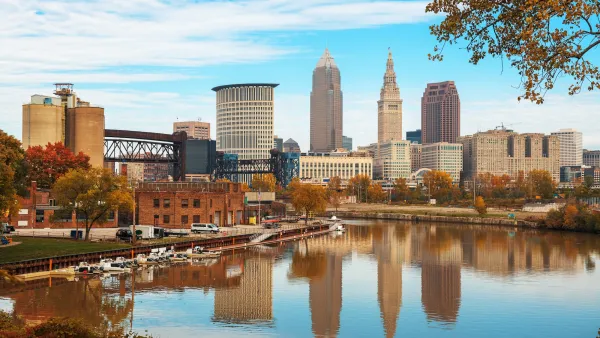
Bringing economic vitality back to Cleveland requires a broad embrace of policies that encourage entrepreneurship, according to Reason's Sam Staley.


"[R]evitalizing Cleveland will require a multi-faceted approach that attempts to harness the creative and entrepreneurial talent of the broadest base possible. This involves nurturing the entrepreneurial talent of existing residents and businesses as well as creating a general business climate capable of attracting and sustaining new businesses and residents. In many cases, the reforms are simply a matter of getting out of the way. The city, for example, limits entrepreneurship in the taxi business by requiring cabs participate in an 'association' of at least 25 cabs, or create a company with a fleet of at least 25 cabs. These rules make it practically impossible for someone to start up a small cab company and build equity in a small business. As a result, entry into the Cleveland cab market has been severely limited for decades."
Staley suggests emulating the transformation of Hong Kong, which has one of the world's most entrepreneur-friendly set of economic policies.
Read the full story: How to Create Real Urban Redevelopment


Learning loss and urban schools, part 2
Did test scores in progressive cities drop more post-COVID than test scores in moderate ones?

Cleveland is turning abandoned real estate into ‘housing innovation district,’ jobs
The city’s housing innovation district will bring pro-housing policies to disinvested neighborhoods.
Cleveland program has housed 200 people since 2024
The A Home For Every Neighbor initiative successfully moves people into housing in under two weeks.

Planetizen Federal Action Tracker
A weekly monitor of how Trump’s orders and actions are impacting planners and planning in America.

California plans to bury El Niño’s downpour
If the state plays its cards right, it may be able to store a billion acre-feet of El Niño’s water in aquifers.

Chicago breaks ground on $3 billion megadevelopment
The new neighborhood, titled Foundry Park, will one day host 3,700 residences.

California High-Speed Rail Authority CEO resigns after $600,000 scandal
Under Ian Choudri, the authority used taxpayer dollars to fund first class flights and trips to nightclubs.

Want to study the Missouri River? Soon, you may need unanimous approval from 10 states
Legislation would require 10 governors’ permission to study or build projects moving water outside the basin.

Desperate measures: Advocates weigh draining Lake Powell to fill Colorado River
Draining the reservoir could reduce evaporation losses by a couple hundred thousand acre-feet.

FREE Course: Walkable City 1: Why Walkability?
After describing his path towards focusing on walkability as the essence of good planning, Jeff Speck marches through his five principal reasons for making more walkable places.
Reinventing Malls: Planning Alchemy—Turning Gray Fields Into Gold
The course focuses on the opportunities and imperatives that shape reinvention of mall sites.

City of Rosemead
Rutgers University, Edward J. Bloustein School of Planning and Public Policy
One Hundred Miles
Hunter College, City University of New York (CUNY)
The Architects Foundation
University of Cincinnati Online
City of Cambridge
Montrose County
The Pocatello Development Authority