The public image of Pittsburgh is of a dirty, industrial city, but the city has been at the forefront of sustainability for some time.


From the Pittsburgh Post-Gazette: "Pittsburgh was into sustainability earlier than most cities and has a deep track record in sustainability and green design," said Donald K. Carter, director of the Remaking Cities Institute at Carnegie Mellon University.
"In fact, Pittsburgh was into sustainability before it was a word. Renaissance I in the late 1940s to the late 1960s included cleaning the air and water and creating Point State Park and Gateway Center out of rail yards and factories."
Reporter Bill Tolan documents the growth of the 2nd wave of Pittsburgh's sustainability movement, starting in 1993. He also highlights what he sees as the difference between "green" and "sustainable," which is that sustainability also focuses on the economically viable.
Read the full story: Cities have been embracing sustainability movement

Pittsburgh Rolls Out Electric School Buses
Pittsburgh Public Schools has launched its first electric school buses, with plans to fully electrify its fleet over the next 14 months, aiming to create a cleaner, more sustainable transportation system supported by new charging infrastructure.

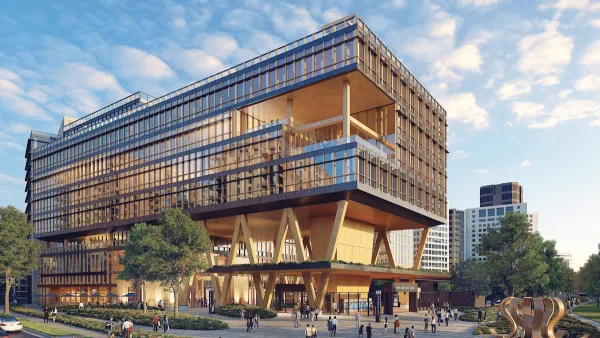
The Search for a New Green Building Standard
The need to slash emissions from buildings is increasingly urgent, and critics say LEED won't get us there.
Op-ed: if transit agencies want sustainability, they should focus on their buildings
In the Washington region, buildings can account for nearly 70% of greenhouse gas emissions. If WMATA wants to be a sustainable agency, it must upgrade its developments as well as its transit.

Desperate measures: Advocates weigh draining Lake Powell to fill Colorado River
Draining the reservoir could reduce evaporation losses by a couple hundred thousand acre-feet.

Eastern Nebraska is running out of electricity
Data centers and electrification are straining eastern Nebraska’s grid, throttling economic development.

Malls are becoming the midtowns of the future
Mall and office park redevelopments are a generational opportunity to create new nodes of urbanity.

NYC breaks ground on anti-flooding infrastructure project
New York City's new system will reduce stormwater flows to local sewers by 90%.

One Kentucky town’s secret to affordable housing
The Smoketown Community Land Trust has already built seven affordable homes for community members.

Houston gains petal-shaped cooling infrastructure to make streets more ‘delightful’
The city has installed the pavilions along 15 blocks in Houston.

FREE Course: Walkable City 1: Why Walkability?
After describing his path towards focusing on walkability as the essence of good planning, Jeff Speck marches through his five principal reasons for making more walkable places.
Reinventing Malls: Planning Alchemy—Turning Gray Fields Into Gold
The course focuses on the opportunities and imperatives that shape reinvention of mall sites.

City of Rosemead
Rutgers University, Edward J. Bloustein School of Planning and Public Policy
One Hundred Miles
University of Michigan School for Environment and Sustainability (SEAS)
Hunter College, City University of New York (CUNY)
The Architects Foundation
City of Cambridge
Montrose County
The Pocatello Development Authority